Affinity Insider | March 2026

There’s a steady flow of headlines, conversations, and decisions competing for our attention. Most of it sits outside our control, yet it still has a way of shaping how we think, how we feel, and how we choose to act.
In environments like this, there’s real value in being intentional about what we shape for ourselves. Where we get information, who we surround ourselves with, and how we create space for our own thinking can anchor us amid the noise. The physical, mental, and emotional environments we build don’t eliminate uncertainty, but they do influence the quality of the decisions we make within it.
This edition of the Affinity Insider is about creating the right environment for good decisions—across taxes, investing, and the day-to-day choices that influence long-term outcomes.
Here’s what you’ll find inside:
💸 Your Finances in Focus — A closer look at how different types of income are taxed, and why small adjustments in structure can meaningfully impact what you keep
📈 Market & Investing Commentary — Signs of broader market leadership and what shifting economic conditions may mean for staying diversified
🎁Featured Article — Three principles that separate reactive tax preparation from proactive planning, and how they can improve financial and life outcomes
📊 Did You Know? — A historical perspective on how markets have behaved during periods of geopolitical uncertainty
🍽️Behind the Scenes — A simple morning in the garden and a reminder of what steady attention and the right environment can create over time.
I appreciate you taking a few moments to read and reflect each month. If something here resonates or raises a question, I’m always glad to continue the conversation.
Let’s begin.
💸Your Finances in Focus
Not All Income Is Created Equal
Two people can earn the same amount and end up keeping very different amounts after taxes. The difference often isn’t how much they make, but how their income is structured.
Salary, bonuses, interest, dividends, capital gains, and retirement withdrawals are all taxed differently. Some are taxed at higher ordinary income rates, others receive more favorable long-term capital gains treatment, and certain types of income can introduce additional layers of tax—such as the 3.8% Net Investment Income Tax, Alternative Minimum Tax (AMT), or Income-Related Monthly Adjustment Amount (IRMAA).
This is just one example of how I’ve been spending time with clients recently. Not trying to overhaul everything, but taking a closer look at where income is coming from, how it’s being taxed, and whether small adjustments could improve the overall outcome.
If helpful, here’s a simple visual we often use with clients to map how different income sources are taxed.
If you’re still in the process of gathering tax year 2025 documents, coordinating with your CPA, or finalizing your return, this is also a natural point to pause and make sure everything is aligned. A quick review now can help surface planning opportunities before filing, rather than after.
Over time, these differences add up. Thoughtful coordination across income sources, investments, and withdrawal strategies can make a meaningful difference in what ultimately stays in your pocket.
📈Market & Investing Commentary
Signs of Broader Market Leadership
After several years dominated by the mega-cap technology companies often referred to as the “Magnificent 7,” the first two months of 2026 are showing signs of broader market participation. Many areas of the market that lagged in recent years are now leading. Value stocks, small-cap companies, international markets, real estate, and even bonds have all outperformed so far this year, what some are calling the “return of the 493.”
Much of this shift reflects valuation dynamics after several years of concentrated gains. As innovation themes like artificial intelligence continue to move through supply chains and into additional industries, more parts of the market may begin to benefit.
Three economic developments shaping markets:
1.📉 Economic Growth Has Moderated
Recent data from the Bureau of Economic Analysis showed the U.S. economy grew at a 1.4% annualized pace in the fourth quarter of 2025, slower than earlier in the year. While some of the slowdown may be tied to temporary factors such as reduced government spending, overall economic activity remains positive.
2. 📊 Inflation Remains Above Target
The Federal Reserve’s preferred inflation measure, Core PCE, came in at 3.0%, slightly higher than the previous reading of 2.8%. While still above the Fed’s long-term 2% target, some of the increase may reflect short-term factors rather than a sustained trend.
3. ⚖️ Supreme Court Limits Emergency Tariff Authority
The U.S. Supreme Court ruled that tariffs imposed under the International Emergency Economic Powers Act (IEEPA) exceeded presidential authority. The Court determined that the law does not authorize the president to impose broad tariffs, reaffirming that tariff powers ultimately belong to Congress.
While the ruling invalidates tariffs imposed under that specific legal authority, it does not eliminate tariffs altogether. Policymakers are already exploring alternative legal mechanisms for trade restrictions, meaning the broader direction of U.S. trade policy remains an evolving story.
The Bottom Line
For investors, the early months of 2026 reinforce an important principle: market leadership rarely stays concentrated forever. Diversification across asset classes, sectors, and geographies helps portfolios adapt as leadership shifts and economic conditions evolve.
As always, we remain focused on helping clients stay disciplined, diversified, and aligned with their long-term goals amid short-term market moves.

🎁Featured Article
Tax Prep vs. Tax Planning: Three Principles to Help You Keep More of What You Earn
As tax season approaches its final stretch, many people are gathering documents, reviewing returns, and making sure everything is filed on time. But preparing a return and planning ahead are two very different things. While tax preparation records what already happened, thoughtful tax planning helps shape decisions before they become permanent.
In this month’s featured article, we explore why proactive tax planning is one of the most effective ways to improve long-term financial outcomes, as well as the three guiding principles that can help you keep more of what you earn.
Inside the article, you’ll learn:
- The difference between reactive tax preparation and proactive tax planning
- Why timing income and deductions can meaningfully affect after-tax outcomes
- How multi-year thinking can unlock opportunities that one-year tax prep often misses
- Why coordination between investments, income, and tax strategy matters
- Three practical principles that help turn tax awareness into better financial decisions
- Whether you’re finalizing this year’s return or thinking ahead to future opportunities, this article offers a clear framework for turning tax awareness into long-term financial advantage.
Whether you’re finalizing this year’s return or thinking ahead to future opportunities, this article offers a clear framework for turning tax awareness into long-term financial advantage.
Click here to read the full article.
Did You Know? 👇
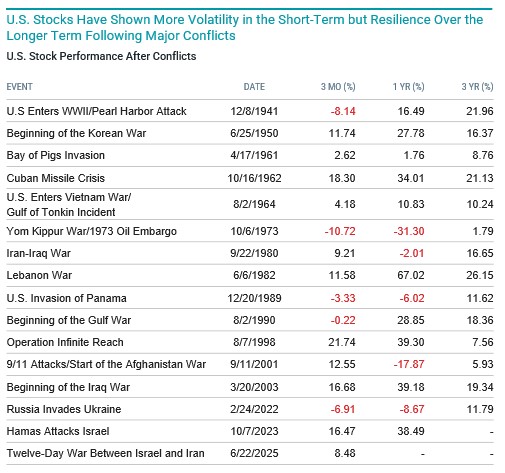
Markets have historically shown resilience even during major military conflicts.
Looking at nearly 100 years of data, U.S. stocks have experienced short-term volatility following events such as Pearl Harbor, the Cuban Missile Crisis, the Gulf War, and 9/11. But over longer periods, the pattern looks very different.
Across the conflicts studied, every three-year period following the start of a major conflict produced positive returns for U.S. stocks, with an average annualized return of about 13%.
This doesn’t mean markets ignore geopolitical risk. In the short run, uncertainty often increases volatility as investors process new information. But history suggests that long-term investors are typically rewarded for staying disciplined rather than reacting emotionally to world events.
In other words, while the headlines may feel dramatic in the moment, the long arc of markets has tended to favor patience, diversification, and sticking to a plan.
Financial takeaway: When uncertainty rises, the goal isn’t prediction. Rather, it’s maintaining a resilient investment plan that can endure whatever the world throws at it.
📰🎧🍿What I’m Reading, Listening To, and Watching
🌍 Iran—Early Considerations on Market Impact (Franklin Templeton)
A measured look at how geopolitical tension may influence markets—and a helpful reminder that disciplined investing tends to matter more than reacting to headlines.
🤖 The AI Bubble: Hidden Risks and Opportunities (Man Group)
A balanced perspective on AI enthusiasm, highlighting where expectations may be stretched and where longer-term opportunities are still developing.
💸 Don’t Fall for This Common Dividend Mistake (Morningstar)
A practical reminder that focusing on yield alone can be misleading, while total return and sustainability matter far more over time.
👨👩👧 How to Tell Your Adult Kids the Bank of Mom and Dad Is Closed (The New York Times)
A thoughtful take on setting financial boundaries with adult children while preserving long-term independence.
🛢️ The Spice Must Flow (Jacob Shapiro)
A big-picture view of energy and geopolitics, highlighting the structural forces shaping markets beyond the short term.
🎧 Sasha Hamdani on ADHD (Armchair Expert Podcast)
A practical look at how ADHD affects motivation, energy, follow-through, and how building the right systems can be more effective than relying on willpower alone.
🏡Behind the Scenes
Sun and Water
My son decided the garden needed water. Lots of water.
This was at an Eco-Tots program at The Ecology Center located in San Juan Capistrano.
I had been meaning to take him for some time. He always enjoys helping his grandfather (“Papa”) in the garden, and we’ve been trying to give him more exposure to where food actually comes from. Mostly though, it felt like a good excuse for a simple father-son outing. Just the two of us outside with nowhere else we needed to be.
The Eco-Tots area is built for little hands and curious minds: kid-sized shovels, wheelbarrows, chalk boards, buckets of dirt, and plenty of watering cans.
Given plenty of exploratory time, he spent most of the morning carefully filling a small watering can, walking it across the garden, and slowly pouring it over flowers and vegetables like they were truly depending on him. Then he’d run back to refill it and do it all over again.
And again.
And again.
At some point I stopped counting, but it had to be twenty trips at least.
Later, the group of kids and parents gathered for circle time while the teachers read Sun Bread. The kids helped mix flour and water before each shaping their own small “sun breads,” which were cooked while everyone shared strawberries, oranges, carrots, and vegetables from the garden.
Afterward we walked through the farm to pick blackberries and feed the chickens before finishing the morning with a bit more play (and yes… more watering).
It was simple. A bit messy. Unhurried.
Watching my little guy move through the garden, I couldn’t help but notice how the morning quietly revolved around two things plants need most: sun and water.
The sun helps things grow.
Water keeps them alive.
Raising kids isn’t all that different. They don’t need perfectly planned days. Just a little warmth, a little attention, and space to explore the world around them.
As we wrapped up the outing, our ambitious gardener proudly carried his sun bread back to the car to show his mom… and then promptly fell asleep.
A pretty perfect morning.
P.S. ~ We spend a lot of time planning for the future, but I’m curious, what’s been a meaningful moment for you lately?



Get the Affinity Insider in your inbox
We respect your privacy and promise to keep your information safe.
EXPLORE TOPICS


Start Your Next Chapter and Pursue Exciting Financial Goals
Click below and schedule a complimentary consultation
Similar Posts


Affinity Insider | February 2026
February 20, 2026

Affinity Insider | January 2026
January 23, 2026

Affinity Insider | December 2025
January 23, 2026
No results found.