Planning Isn’t About Guessing Returns, It’s About Building Resilience

How a disciplined investment process helps investors stay grounded when markets, headlines, and narratives compete for attention
A quick roadmap
If markets and headlines feel noisy or distracting, this article is meant to be a steadying read. Here’s the core message:
- Markets can be unpredictable in the short-term , but investor behavior doesn’t have to be
- A resilient investment process matters more than forecasts
- Well-designed portfolios are built to adapt, not react
You can read this start to finish, or jump to the sections that matter most right now.
If you’ve ever caught yourself wondering whether you should be doing something, anything, because of a headline you read this week, you’re not alone.
Most investors today aren’t short on information.
They’re drowning in it.
Every day brings a new narrative: a breakthrough technology, a looming risk, a bold prediction about what markets must do next.
The result isn’t clarity. It’s tension.
A sense that you might be missing something, falling behind, or failing to act when action is required.
Over time, that constant noise erodes confidence and encourages short-term thinking—even among thoughtful, disciplined investors.
This is where it helps to pause and reframe the goal.
Planning isn’t about guessing returns.
It’s about building resilience.
The Trap of Needing to Be “Right”
Markets have a long history of humbling confident predictions.
Year after year, highly credentialed strategists publish precise forecasts only to see outcomes diverge, sometimes dramatically, from what was expected.
This isn’t a failure of intelligence or effort. It’s a reminder of what markets actually are: Complex systems shaped by human behavior, incentives, emotions, and feedback loops.
And yet, many investors still feel pressure to respond to every new development as if the right move is just one insight away.
That pressure creates a familiar cycle:
Over time, this cycle creates a quiet but meaningful drag on results. Not because the underlying investments are flawed, but because reactive decisions made under pressure tend to work against long-term compounding.
The gap between how markets perform and how investors actually experience those returns is often behavioral, not structural.
The problem isn’t that investors care about markets.
It’s that they’re being asked, implicitly or explicitly, to predict them. The poor track record of forecasts isn’t an anomaly. It’s a feature of systems driven by shifting incentives, expectations, and human behavior.
Prediction vs. Preparation: Why This Matters in Real Portfolios
There’s a critical distinction worth making.
Short-term prediction tries to forecast precise outcomes over the next 6–12 months.
Long-term preparation accepts uncertainty and designs around it.
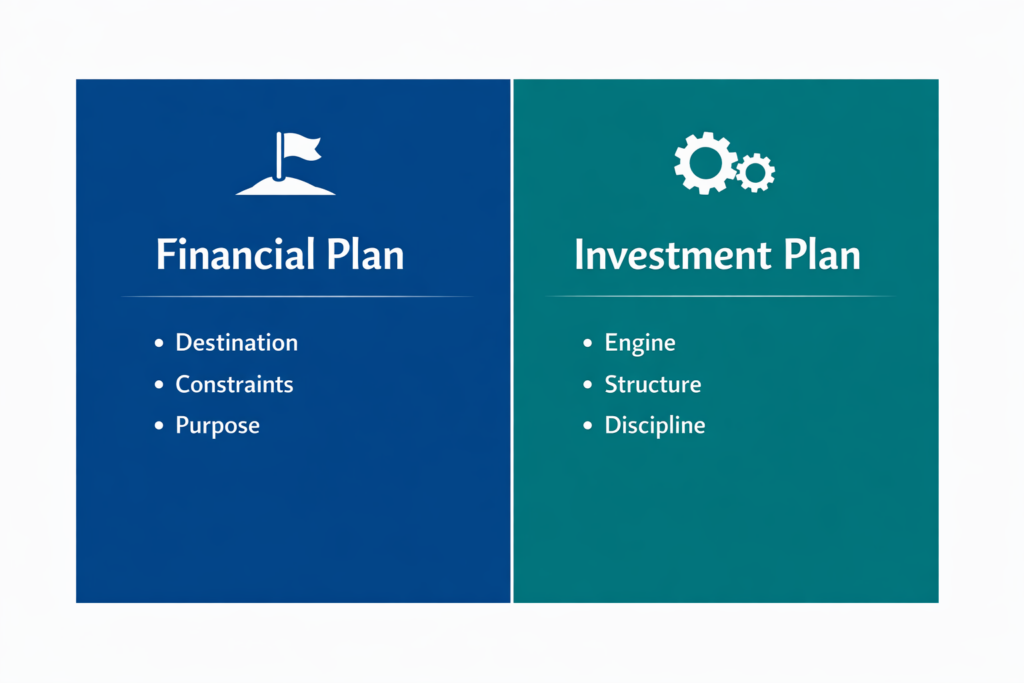
A well-constructed financial plan defines the destination and constraints: goals, time horizons, spending needs, flexibility, and tradeoffs.
A disciplined investment plan then serves as the engine, designed to operate through a wide range of market environments without constant intervention.
This distinction matters. When markets are volatile, it’s easy to assume something is “wrong” with the portfolio. More often, what’s happening is that markets are behaving as they sometimes do—and the investment plan is doing its job inside a financial plan that anticipated uncertainty.
Resilient planning doesn’t eliminate volatility.
It prevents volatility from forcing poor decisions.
Volatility isn’t a flaw in markets; it’s the cost of participation, a distinction we explore more fully in our separate discussion on risk and volatility.
Part of what makes this difficult is that most of the real work compounding does happens quietly and unevenly. Small gains build on prior gains over long periods, without a clear feedback loop to reassure us along the way.
What We Pay Attention To and What We Intentionally Ignore
In our work with clients, we spend far less time asking what markets will do next and far more time focusing on questions like:
- What does this financial plan need to support over time?
- How dependent is success on one outcome going right?
- Where may frictions like costs, taxes, turnover, and complexity be quietly eroding results?
- Does portfolio structure support meaningful compounding growth with minimal intervention?
- How flexible is spending if markets disappoint?
- Where are concentration and behavioral risks quietly building?
- What decisions are most likely to be regretted later?
Just as important, there are things we intentionally spend less time on:
- Short-term market calls
- Hot investment narratives
- Year-by-year return targets
- Reacting to financial media urgency
Not because markets don’t matter, but because process matters more.
A thoughtful investment plan isn’t designed to predict markets.
It’s designed to stay in service of the financial plan when markets become uncomfortable.
For those who want a deeper look at how this philosophy is translated into portfolio construction and ongoing decision-making, we outline our investment approach here.
Using 2026 Market Themes as Context, not a Crystal Ball
Each year, we review a wide range of long-term market outlooks from respected research organizations with different methodologies and perspectives.
No single outlook drives decisions.
The value comes from identifying shared themes, areas of disagreement, and risks worth acknowledging—then using that context to pressure-test assumptions rather than chase outcomes.
Vanguard’s 2026 Economic and Market Outlook offers a useful illustration of how this research informs planning—not by dictating portfolio changes, but by shaping long-term investment assumptions that support the broader financial plan.
Three themes stand out.
1️⃣ Artificial Intelligence: Progress Isn’t the Same as Profit
Artificial intelligence has the potential to improve productivity across the economy over time. That much is widely agreed upon.
What’s easier to overlook is the gap between economic impact and investment returns.
Major technological shifts typically require enormous upfront investment before benefits materialize. The companies building the infrastructure often face pressure on margins and cash flows long before rewards show up, and markets can price in optimistic outcomes well in advance.
As a result, expectations can run ahead of fundamentals.
The planning implication:
Artificial intelligence has the potential to be a powerful driver of productivity across the economy over time. As use cases expand and adoption broadens, the technology could help ease inflation pressures. That’s a real and meaningful development.
But economic progress doesn’t always translate neatly into investment returns, especially when expectations become concentrated around a small group of companies or a single narrative.
Rather than concentrating portfolios around a narrow set of perceived “AI winners,” this environment reinforces the importance of measured position sizing, broad exposure, and rebalancing. The goal is to participate in innovation without allowing any one theme, technology, or company to carry more weight than it should. In other words, we want portfolios that can benefit if AI delivers on its promise without becoming overly dependent on a perfect outcome.
2️⃣ Higher-for-Longer Rates Change the Investment Landscape
Another theme appearing across many outlooks is the likelihood that interest rates remain meaningfully higher than what investors experienced during the last decade.
In an environment of steady growth and persistent inflation pressures, central banks may have less flexibility to cut rates aggressively.
That has consequences:
- Cheap capital becomes less available
- Future earnings are discounted more heavily
- Lower-risk assets become more competitive
The planning implication:
For investors, this doesn’t call for defensiveness. It clarifies how high-quality bonds and cash can provide income, stability, and liquidity—supporting prudent allocation and reducing reliance on equities to deliver every outcome.
3️⃣ More Modest Returns and Greater Dispersion Ahead
Perhaps the most important takeaway from long-term market research isn’t any single number.
It’s the expectation that future returns may be:
- more modest
- more uneven
- more dependent on starting valuations
Valuations still matter. Periods of market leadership tend to cluster, and then rotate, often in ways that feel obvious only in hindsight. Some parts of the market are still priced for strong outcomes, while others reflect much more modest expectations.
The planning implication:
With valuations still elevated in parts of the market and leadership increasingly concentrated, long-term return potential is likely to be more dispersed than it has been in recent years.
This creates a stronger case for global diversification and exposure beyond the largest U.S. growth companies—including smaller companies, value-oriented strategies, and international markets.
In an environment where the U.S. economy remains supported by healthy private-sector balance sheets, historically strong all-time-high household wealth, and ongoing investment in areas like technology, infrastructure, and reshoring, long-term growth doesn’t have to rely on a narrow set of winners.
A broadly diversified portfolio, paired with disciplined rebalancing over time, is a more reliable way to capture opportunity wherever it emerges.
Diversification reduces dependence on being exactly right.
Why This Matters More Than Any Forecast
The exact numbers in today’s outlooks will eventually be wrong.
What matters is how they influence decisions:
- Are financial plan assumptions realistic?
- Is the investment plan resilient to disappointment?
- Does success depend on one narrow outcome?
- Is there a clear framework for adjusting when conditions change?
When the financial plan is sound, the investment plan doesn’t need to react emotionally.
It simply needs to do its job.
Anchors to Return To When Markets Get Loud
When headlines feel urgent or confusing, these principles help bring investors back to center:
- Update assumptions intentionally, not emotionally: Planning inputs should evolve thoughtfully, not in reaction to noise.
- Stress-test the financial plan so the investment plan doesn’t panic: Confidence often comes from knowing you’ve already considered what could go wrong.
- Diversification reflects humility, not indecision: It reduces reliance on any single narrative being right.
- Structure creates freedom: Clear guidelines around rebalancing, spending, and risk reduce emotional decision-making.
- Money is a tool, not a scoreboard: Its purpose is to support wellbeing, flexibility, and meaningful life goals.
Shortcuts often feel like progress, but frequently turn into setbacks.
Discipline, structure, and patience compound more reliably than insight.
A Steadier Way Forward
Markets will always surprise us. New narratives will always compete for attention.
You don’t need an investment plan that predicts the future.
You need one that remains aligned with a thoughtful financial plan when uncertainty rises.
Planning doesn’t offer certainty. It offers something more useful:
confidence that decisions are being made with purpose, not urgency.
When questions arise, as they inevitably do, that’s not a failure of planning. It’s part of engaging with it thoughtfully over time.
Disclaimer: This article is for general informational purposes only and is not intended to provide, and should not be relied on for, legal, tax, or accounting advice. Please consult a qualified estate planning attorney or tax advisor regarding your individual circumstances.
Get the Affinity Insider in your inbox
We respect your privacy and promise to keep your information safe.
EXPLORE TOPICS


Start Your Next Chapter and Pursue Exciting Financial Goals
Click below and schedule a complimentary consultation
Similar Posts



No results found.