Affinity Insider | December 2025

This time of year tends to live in the in-between, wrapping up one chapter while quietly preparing for the next.
In life and in finances, the most durable decisions don’t depend on perfect forecasts or precise timing. They depend on creating the right environment, one that supports clear thinking, flexibility, and confidence as conditions evolve.
This edition of the Affinity Insider is about creating the right conditions for good decisions in markets, in planning, and across life’s many transitions.
Here’s what you’ll find inside:
💸 Your Finances in Focus — A reflection on a year defined by life’s real moments, steady growth built on trust, and how preparation creates room to respond thoughtfully when circumstances change.
📈 Market & Investing Commentary — A discussion on market momentum, the Fed’s accommodative stance, and seasonal optimism from investors.
🎁Featured Article — A practical framework for managing concentrated stock exposure, balancing risk, taxes, and opportunity while staying aligned with long-term goals.
📚 What I’m Reading, Watching & Listening To — Curated ideas on career leverage, a goal-setting roadmap used by Shohei Otani, and the intersection of economic and cultural change.
🦆 Behind the Scenes — A first trip to the movie theater and a reminder that readiness and environment often matter more than the event itself.
As always, thank you for letting this newsletter be part of an ongoing conversation, one built on trust, perspective, and walking alongside you through whatever comes next.
Let’s begin.
💸Your Finances in Focus
A Year of Showing Up for Life’s Defining Moments
As the year comes to a close, it feels right to pause and reflect on the moments that truly mattered.
In 2025, our work was shaped less by calendars and more by life itself. While money is part of the conversation, the deeper purpose of financial planning is preparation and balance—helping create steadiness, perspective, and flexibility as life unfolds.
Walking Beside You Through Life’s Transitions
This year, we had the privilege of supporting clients through a wide range of life events—many joyful, some deeply difficult, all meaningful.
We helped families navigate the loss of loved ones, settle estates, and make decisions during emotionally heavy times.
We celebrated new beginnings: the birth of a child, marriage, international travel, and cross-country moves into new homes.
We worked through career changes on both ends of the spectrum—from promotions and new opportunities to unexpected layoffs and uncertainty.
We also supported clients taking entrepreneurial leaps and building something new.
Five Years of Steady, Intentional Growth
This year marked a five-year milestone for Affinity Financial—a meaningful moment of reflection for our firm. It reinforces something we believe deeply: sustainable growth comes from trust, consistency, and showing up day by day.
Since its founding in 2020, the firm has grown by at least 20% each year, including the addition of nine new client relationships in 2025 alone. What matters most to us isn’t the pace of that growth, but its source. Much of it has come through warm introductions from existing clients who have invited friends, family members, and colleagues into a conversation with us. As a largely referral-based firm, we see each introduction as an expression of trust, not a transaction. Our ability to grow is fueled by the opportunity to work with exceptional individuals, people we genuinely enjoy working with and feel privileged to support over the long term.
Expanding Services Where They Matter Most
As client needs evolved, so did our wealth management service offering.
This year, we introduced and expanded services designed to meet real-world challenges:
- High-yield savings solutions for smarter cash management,
- Estate plan document creation and review to help ensure intentions are clearly documented, and
- Continued enhancements to our suite of tax-efficient investment strategies
A Year of Ongoing Education and Clear Communication
Clarity doesn’t happen by accident, it’s built through consistent and thoughtful communication.
As committed to in January, the Affinity Insider newsletter has gone out every month in 2025, providing perspective on markets, planning, and decision-making. Alongside it, we have published at least one in-depth article to explore foundational wealth and life transition frameworks—from navigating major tax law changes to understanding investment risk, stock concentration, and asset allocation in retirement.
Our goal has been simple: to help you think more clearly about money and life in a world that often makes things feel overwhelming.
Steady Into the New Year
As we turn the page on 2025, our focus remains unchanged.
We’re here to prepare thoughtfully, respond compassionately, and walk alongside you through whatever life brings next, whether it is expected or not.
Thank you for the trust you place in us. It’s something we never take lightly.
📈Market & Investing Commentary
Markets moved higher in November as investors navigated a lighter economic calendar, a pivotal Federal Reserve meeting, and growing optimism heading into year-end. With inflation data cooperating and the Fed reinforcing a supportive stance, confidence continued to build that the economy may achieve a rare balance: moderating inflation without tipping into recession.
1. An Accommodative Federal Reserve
The Fed officially cut overnight interest rates by 0.25% on Wednesday, December 10, 2025, to a range of 3.50% to 3.75%. Additionally, expectations for future cuts were updated, as the Fed now anticipates one additional rate cut in 2026 and another in 2027, guiding policy toward a long-term “neutral” rate near 3%.
While a single cut per year may seem modest, it signals a continued accommodative posture. A stable-to-lower interest rate environment over the coming years is generally supportive for economic growth, corporate earnings, and financial markets.
2. Healthy Economic Data (Despite Limited Releases)
Economic data releases were sparse in November due to the government shutdown, but one critical report arrived just in time for the Fed meeting: the Personal Consumption Expenditures (PCE) index.
Core PCE, the Fed’s preferred inflation gauge because it excludes volatile food and energy prices, came in at 2.8% year-over-year. This reading was lower than the prior month and below expectations, reinforcing the view that inflation has stabilized. It provided the confirmation the Fed needed to move forward with a December rate cut and strengthened confidence that inflationary pressures may continue to ease.
3. The Santa Claus Rally Effect
Historically, December has been a strong month for equities, a phenomenon often referred to as the “Santa Claus Rally.” Seasonal optimism, year-end portfolio adjustments, and holiday spending can all contribute to positive market momentum.
Investor sentiment supports this narrative, with the AAII Sentiment Survey showing bullishness near its highest level of the year. FactSet reports 83% of S&P 500 companies have surprised on earnings results, and 76% have had a positive revenue surprise.
Looking Ahead
Overall, the combination of declining interest rates and a healthy, growing economy — rather than a recession-driven slowdown — has historically been a constructive backdrop for stock market returns. With no major economic storm clouds on the horizon, the Fed reaffirming its accommodative stance, and investor optimism on the rise, market strength could persist into year-end and beyond.
As always, we remain focused on helping clients stay disciplined, diversified, and aligned with their long-term goals amid short-term market moves.

🎁Featured Article
Managing Concentrated Stock Exposure: Balancing Taxes, Risk, and Opportunity
When a single stock becomes a major part of your wealth, it can create both opportunity and risk. Concentration can amplify gains, but also magnify losses and limit flexibility.
This month’s feature explores how to protect what you’ve built while remaining positioned for future growth.
Inside the article, you’ll learn:
- Why even great companies can underperform over time
- How to balance conviction, control, and diversification
- A tiered framework for managing concentration risk
- Tax-smart strategies to stay invested while reducing exposure
- Ways to monetize stock without selling, including margin loans and structured solutions
- How tax-loss harvesting, hedging, and charitable strategies can work together to reduce risk and improve after-tax outcomes
Whether your concentrated stock holdings come from years of hard work or market success, this guide can help you turn that achievement into enduring wealth that supports the life you want.
Click here to read the full article.
Did You Know? 👇
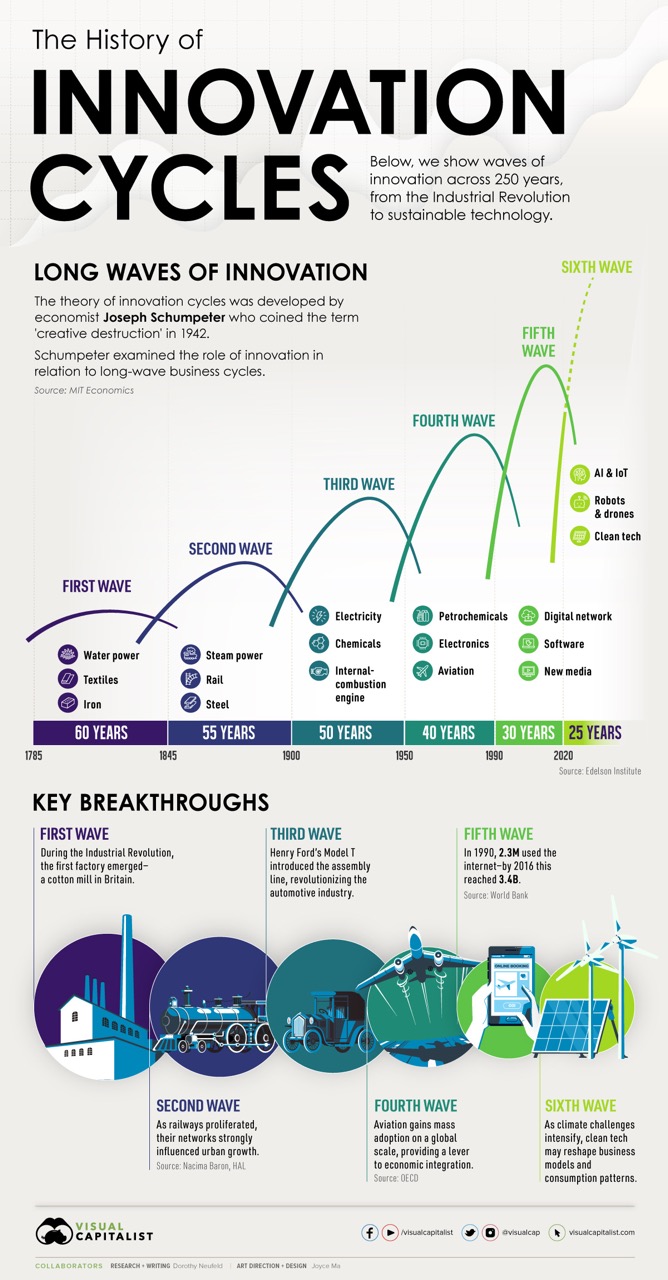
Innovation tends to unfold in long, multi-decade cycles rather than in isolated breakthroughs. Each wave introduces technologies that transform productivity, reshape industries, and create new market leaders while older business models gradually phase out.
For investors, these cycles serve as a reminder that long-term progress is uneven but persistent, and that diversified portfolios naturally benefit as each new era emerges and scales.
The six major innovation waves since the late 1700s include:
- 1st Wave: Textiles & water power kick off the industrial era
- 2nd Wave: Steam power and railways transform transport and trade
- 3rd Wave: Electricity and mass production drive 20th-century industry
- 4th Wave: Petrochemicals, electronics, and aviation expand global connectivity
- 5th Wave: Digital networks, software, and the internet redefine communication
- 6th Wave (emerging): AI, IoT, robotics, and sustainable technologies may be shaping the next frontier
Understanding where we are in these cycles can help investors appreciate how technological progress drives economic growth, and why patience and adaptability remain core to long-term planning.
📰🎧🍿What I’m Reading, Listening To, and Watching
☕ The Coffee Bank and the Speed of Change (Andrew Montgomery) — A reflection on how small daily rituals reveal and reinforce the accelerating pace of cultural and economic change around us.
🎯The Harada Method: How to Achieve Ambitious Goals (Sahil Bloom)— An overview of a disciplined Japanese self-improvement framework designed to turn big, audacious goals into consistent, measurable action.
📈 Why you probably have a low leverage career, and how to create more leverage (Rick Foerster)— An exploration of why most professionals remain capped by linear output and how to intentionally build systems, scale, and strategic leverage into a career.
🪞 Part 1: My Life Is a Lie (Michael Green) — A personal and economic commentary on the illusions we build around identity, success, and systems that ultimately shape our choices and worldview.
💬 Poverty Level Discourse (John Mauldin)— A critique of how political and economic conversations oversimplify complex issues around poverty, often missing the structural challenges that matter most.
🏡Behind the Scenes
A First Time at the Big Screen
A few weeks ago, I took our son to the movie theater for the first time.
The movie was Zootopia 2, a familiar and comforting choice. The story returns to a city where animals of every kind coexist, navigating differences, expectations, and change. We had watched the first Zootopia many times at home, and that familiarity mattered.
What made this experience different wasn’t the movie, it was the setting.
At three and a half, our son is used to watching movies in pieces. Fifteen minutes here. Forty-five minutes there. At home, there’s light, movement, snacks on demand, and a pause button. A movie theater removes all of that: a dark room, loud speakers, a huge screen, and no stopping once it begins.
Knowing that, we talked about it ahead of time. What the room would feel like. That it would be darker. That the sound would be louder. That we’d sit together the whole time. The goal wasn’t to over-prepare, just to build comfort before the moment arrived.
The environment helped, too. This wasn’t a packed public showing. The movie was part of a birthday celebration for a close friend’s seven-year-old son. The theater was filled with familiar families, well-behaved kids, and parents who all shared an understanding of the moment.
When the movie started, his first reaction was to bury his head into my body. Then came a big hug and squeeze, followed by a cautious peek at the screen. Eventually, I turned him around so he could face it more easily, still sitting on my lap in the same oversized recliner chair (fortunately big enough for both of us).
Once settled in, he was fully engaged. He watched intently, enjoyed his Kit Kat chocolates (larger than the mini size he was used to) and learned how to snap the two bars apart. We talked about eating one now and saving the other for later. “Later,” as it turned out, was only a matter of minutes.
There was one firm rule from him. I was not allowed to touch the recliner button. I don’t even know if he knew what it did, but the glowing button was clearly off limits. I obediently complied.
When the movie ended, calm gave way to joyful chaos—cake, kids marching up and down the stairs, and energy in every direction. But during the movie itself, there was something quietly special about the experience. Kids and parents across ages and stages sharing the same space, each of us meeting the moment in our own way.
In addition to the novelty of his first movie theater visit, what stayed with me afterward was the reminder that firsts are rarely about the event itself. They’re about readiness, and about the environment that surrounds the experience.
We didn’t rush independence or insist things go exactly as planned. We created familiarity where we could, talked through what to expect, chose a supportive setting, and stayed flexible when the moment arrived.
That approach applies far beyond parenting.
In financial planning, the most successful decisions tend to follow a similar pattern. It’s not just about what decision is being made. It’s about whether the conditions support it. The right structure, expectations, and environment often matter more than perfect timing.
That afternoon at the theater worked not because everything was controlled, but because we were prepared, supported, and ready for whatever came next. A small first, but a meaningful reminder that thoughtful preparation creates space to be present and enjoy the moment as it unfolds.
P.S. ~ Many meaningful moments go well because of what happened before they began. What preparation has helped you be more excited, ready, and present?


Are you overpaying taxes?
Take the 2-minute quiz to find out.
EXPLORE TOPICS


Start Your Next Chapter and Pursue Exciting Financial Goals
Click below and schedule a complimentary consultation
Similar Posts

Affinity Insider | October 2026
October 16, 2026
Affinity Insider | September 2026
September 22, 2026

Affinity Insider | August 2026
August 27, 2026
No results found.