Affinity Insider | February 2026

This time of year can feel like a lot, with tax documents, market headlines, and important decisions competing for attention. More often than not, though, real progress comes from having the right structure and alignment in place, not from rushing or reacting.
This edition of the Affinity Insider is about slowing that moment down and using planning windows more intentionally—whether that’s before a tax return is filed, amid shifting market narratives, and in the everyday systems that support long-term progress.
Here’s what you’ll find inside:
💸 Your Finances in Focus — Why tax season is a planning opportunity, not just a compliance deadline
📈 Market & Investing Commentary — Using 2026 themes as context, not a crystal ball
🎁Featured Article — Why resilient investment planning matters more than guessing returns
📊 Did You Know? — A visual reminder of why global diversification works
🍽️Behind the Scenes — An honest moment from our family’s dinner table, where progress showed up not through effort or force, but through structure, patience, and consistency.
As always, this newsletter is part of an ongoing conversation. If something here sparks a question or a next step, I’m always glad to talk it through.
Let’s begin.
💸Your Finances in Focus
Tax Season Is a Planning Opportunity
Earlier this week, we shared a detailed email outlining how we support clients during tax season—from getting organized to reviewing key decisions before filing. If you haven’t had a chance to review it yet, you can view that message here and bookmark it as a reference for the weeks ahead.
While tax filing is often viewed as a compliance exercise, we see this time of year as a planning window. Decisions made before a return is finalized—around retirement contributions, equity compensation, real estate or business activity, and state-specific considerations—can meaningfully impact outcomes, both this year and beyond.
That’s why our approach emphasizes coordination and timing, not just paperwork. When information is shared early and reviewed thoughtfully, it creates momentum and allows us to be proactive rather than reactive.
Whether you’re just getting started or already deep into the process, tax season works best when it’s structured, well-coordinated, and aligned with your broader financial plan.
If you haven’t already, reviewing that email and taking one small next step—whether organizing documents or scheduling a planning conversation—can help keep things moving smoothly.
📈Market & Investing Commentary
Using 2026 Themes as Context, Not a Crystal Ball
Each year, we review long-term outlooks from respected research organizations, including Vanguard and others, to identify shared themes and pressure-test assumptions. No single forecast drives decisions, but recurring patterns help guide prudent portfolio positioning.
Three themes continue to stand out for 2026
1.🤖 Artificial Intelligence: Progress ≠ Profit
AI has the potential to improve productivity and support long-term economic growth. But markets have already priced in significant optimism around a narrow group of companies.
Portfolio impact:Rather than concentrating around perceived “AI winners,” portfolios have remained broadly diversified with disciplined position sizing and rebalancing. This allows participation in innovation without becoming dependent on a single narrative, a discipline that has helped manage risk during periods of enthusiasm.
2. 💵 Higher-for-Longer Rates
Interest rates are likely to remain higher than what investors experienced during much of the last decade. That changes the opportunity set.
Portfolio impact: High-quality bonds and cash have once again become meaningful sources of income and stability. This supports prudent allocation and rebalancing, while reducing reliance on equities to deliver every outcome.
3. 🌍 More Dispersion in Returns
Future returns may be more uneven and valuation-dependent than in recent years. Some areas remain priced for strong outcomes, while others reflect more modest expectations.
Portfolio impact: This reinforces global diversification and exposure beyond the largest U.S. growth companies — including small- and mid-cap stocks, value-oriented strategies, international markets, and commodities. As leadership has shifted, this broader allocation has contributed positively.
The Bottom Line
We use market outlooks as context, not predictions. The focus remains on resilient, well-diversified portfolios designed to adapt across a wide range of environments.
As always, we remain focused on helping clients stay disciplined, diversified, and aligned with their long-term goals amid short-term market moves.

🎁Featured Article
Planning Isn’t About Guessing Returns, It’s About Building Resilience
In a world flooded with market headlines, short-term forecasts, and urgent predictions, it’s easy to feel pulled in every direction. Most investors aren’t short on information, they’re short on clarity. Unfortunately, reacting to every narrative often leads to decisions that work against long-term goals.
In this month’s featured article, we explore why effective investment planning should focus less on trying to guess returns and more on building resilience, the kind that helps you stay aligned with a thoughtful financial plan through uncertainty, volatility, and changing conditions.
Inside the article, you’ll learn:
- Why chasing forecasts and market narratives often undermines long-term results
- What resilience means in the context of investment and financial planning
- How structure and discipline help reduce emotional decision-making
- The distinction between short-term prediction and long-term preparation
- How a resilient investment approach supports goals across market cycles
- Practical principles that bring clarity and confidence when markets feel noisy
Whether you’re navigating volatility, reviewing your investment strategy, or simply looking for a steadier way to make decisions, this article offers a calm framework for focusing on what matters most over time.
Click here to read the full article.
Did You Know? 👇
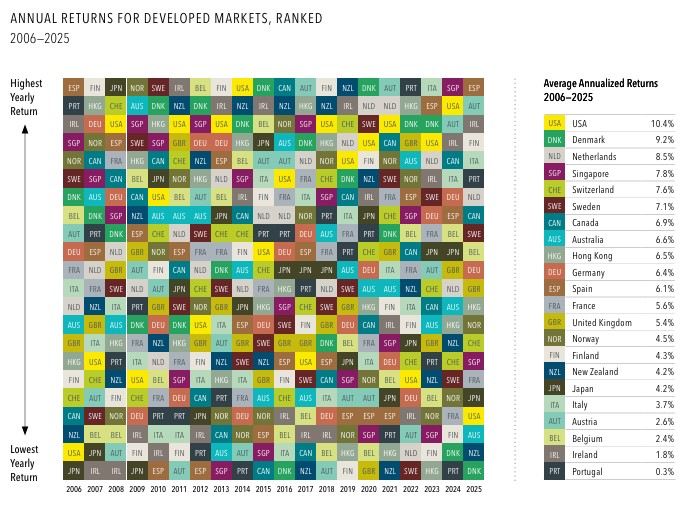
Looking at past market performance offers very little help in predicting future winners.
The chart below shows 20 years of annual returns across 22 developed markets, ranked each year from best to worst. What stands out isn’t consistency, but constant change.
The wide dispersion of colors highlights how unpredictable leadership can be. For example, New Zealand delivered the highest market return in 2019, only to rank last just two years later in 2021. Similar shifts appear across nearly every market over time.
This unpredictability is precisely why global diversification matters. When one country underperforms, others may lead, helping smooth the overall investment experience and reducing reliance on any single market.
Bottom line: A globally diversified portfolio doesn’t aim to pick winners. It’s designed to participate broadly, improving the odds of more consistent, reliable outcomes over time.
📰🎧🍿What I’m Reading, Listening To, and Watching
🔮 Five Questions for 2026 (Caryle) — A forward-looking set of strategic questions to help investors frame uncertainty and focus on what matters most this year.
🎥 Everything Everywhere All at Once: Conglomerates and the Disappearing Diversification Discount (Research Affiliates)— An analytical look at why diversified conglomerates no longer trade at steep discounts and what that shift reveals about capital allocation and business complexity.
📈All You Need To Know About Warsh (The Macro Compass)— Economic ideas and influence from former Fed Governor Kevin Warsh and what they mean for today’s markets.
🔥 If You Hate Inflation, Then You’ll Love Stocks (Sam Ro)— An argument that persistent inflation reshapes valuations in ways that can ultimately benefit equities over the long term.
🧩 Microsoft and Software Survival (Stratechery) — A sharp analysis of how platform shifts test whether dominant software companies can truly adapt, and what separates durable incumbents from those quietly at risk.
🏡Behind the Scenes
Progress on the Plate
Dinner used to feel harder than it needed to be.
Like many kids his age, our son has a small circle of foods he trusts. Not unusual. But we want him to grow into a healthy, confident eater, and his narrow comfort zone made that feel harder than it should be.
A new food would land on his plate and the reaction was immediate. “No.” Sometimes loudly. Sometimes before the plate even hit the table. The request was always the same: please take it away.
After months of the same pattern, it became clear we needed to rethink our approach.
We had seen how responsive he was to structure during potty training: clear expectations, positive reinforcement, and room to progress at his own pace. So rather than pushing for the outcome, we focused on the process.
We borrowed from an evidence-based framework known as Feeding Littles, which emphasizes structure, repeated exposure, and patience over pressure, and changed the system. One new food on the plate each night. Always paired with something safe and familiar. No pressure to eat it. Just an expectation to engage.
We defined four kinds of progress:
- Touch the food
- Smell the food
- Leave it on the plate
- Taste the food
Each positive act earned a sticker. After six stickers, he earned a reward, not candy or prizes, but shared moments: a family dance party, an extra bedtime book, a dinosaur bath bomb. He takes real pride in adding each sticker.
At first, nothing dramatic happened. No breakthrough. No sudden expansion of his menu.
But the tone shifted. The plate stayed calm. Touching turned into curiosity. Smelling became routine.
What had once been disruptive became an opportunity for learning, confidence, and small wins everyone could celebrate.
This wasn’t about perfection. It was about progress, designed, supported, and repeated.
Is this the best approach? Impossible to know. Parenting comes with no shortage of opinions. What matters to us is that it feels sustainable, positive, and aligned with the long-term version of the story we hope he’s writing.
Most meaningful change seems to work this way. Not through pressure or perfect execution, but through systems that create safety, clarity, and room to grow.
When the system is aligned with the long-term goal, progress has a way of showing up, slowly, unevenly, and often more sustainably than we expect.
P.S. ~ Where in your own life might progress be waiting for a better system, not more effort?



Are you overpaying taxes?
Take the 2-minute quiz to find out.
EXPLORE TOPICS


Start Your Next Chapter and Pursue Exciting Financial Goals
Click below and schedule a complimentary consultation
Similar Posts


Affinity Insider | October 2026
October 16, 2026
Affinity Insider | September 2026
September 22, 2026
Affinity Insider | August 2026
August 27, 2026
No results found.