Affinity Insider | April 2026

In my role, much of the early part of the year is spent working closely with clients as tax returns come together and major planning decisions take shape. Once the April 15 deadline passes, it creates a natural pause point—a moment when returns are being finalized, markets are adjusting to new expectations for the year ahead, and many households are taking stock of where things stand before moving into the next stretch of the year.
Periods like this are a useful reminder that meaningful financial progress rarely depends on any single decision. More often, it reflects the strength of the structure around us—how financial resources support life priorities, how investments remain diversified across changing environments, and how the relationships we rely on help us move forward with confidence. Robust financial lives are usually built this way: through coordination, flexibility, and commitment over time.
This edition of the Affinity Insider is about strengthening the structure behind your decisions so that your finances, investments, and relationships continue supporting you across changing conditions.
Here’s what you’ll find inside:
💸 Your Finances in Focus — How restructuring debt thoughtfully can improve cash flow and better support the decisions you’re already making.
📈 Market & Investing Commentary — What shifting market leadership beneath the headlines suggests about the role diversification continues to play.
🎁Featured Article— Three tax planning strategies high earners can use to strengthen long-term financial flexibility.
📊 Did You Know? — Why early 2026 index performance looked weaker than what most individual companies or diversified investors actually experienced.
🎢Behind the Scenes — A reminder from some Disneyland milestones that preparation often helps us discover we’re ready for what’s next.
I’m grateful for the opportunity to share these reflections with you each month. If something here connects with what you’re thinking about right now, I’m always glad to continue the conversation.
Let’s begin.
💸Your Finances in Focus
Restructuring Debt to Support the Decisions You’re Already Making
Over the past several months, I’ve had conversations with a number of clients who were in the middle of improving their homes or investment properties—projects that meaningfully enhanced how they live and what their assets can support over time. In several cases, those improvements had been temporarily financed with credit cards carrying interest rates above 25%.
Once we stepped back and looked at the full picture together, we were able to restructure that debt using Home Equity Lines of Credit (HELOCs) closer to 7%, reducing interest costs and easing monthly cash-flow pressure in a meaningful way.
What stood out most wasn’t the availability of the strategy. It was that many thoughtful, financially engaged households simply hadn’t realized it was an option available to them.
Part of financial planning isn’t avoiding debt altogether. It’s making sure the structure of your borrowing supports the decisions you’re already making intentionally. In other situations, we’ve helped clients access liquidity without selling investments by borrowing against portfolio assets through securities-backed lending. Used carefully, these approaches can preserve long-term investment positioning while improving short-term flexibility.
This kind of coordination is a core part of how we work, meeting you where things stand today and helping align your resources so they support where you want to go next.
If you’ve been thinking about using home equity for renovations, debt restructuring, or a large planned expense, I’ve included a short guide that walks through three common approaches:
📄Common Home Equity Options: HELOC, Home Equity Loan, and Cash-Out Refinance
It outlines how each strategy differs in structure, timing, costs, repayment expectations, and when each tends to be most appropriate.
The goal isn’t to encourage borrowing. Rather, it’s to make sure the tools available to you are working with your financial plan, not against it. When used intentionally, access to liquidity can create flexibility, reduce friction, and support decisions already aligned with your priorities.
📈Market & Investing Commentary
Q1 2026: A Broader Market Beneath the Headlines
At a headline level, 2026 has been a more uneven year for investors than the last several. Markets began the year near record highs but experienced periods of volatility as investors weighed geopolitical tensions, rising energy prices, and shifting expectations for interest-rate policy. Even so, global equities remain near long-term highs and economic growth expectations continue to point toward expansion rather than contraction.
What stands out about 2026 so far isn’t the volatility itself. It’s the shift in leadership underneath the surface.
After several years dominated by a narrow group of large U.S. technology companies, returns have begun to broaden across regions, sectors, and company sizes. International stocks, value-oriented companies, and small-cap equities have all played a larger role in market performance this year. Historically, periods like this often mark a transition toward more balanced return drivers across markets—an encouraging development for diversified investors.
This combination of uncertainty in the headlines and broader participation beneath the surface is a familiar pattern in markets and one that often supports more durable long-term progress than periods driven by a single segment of the market.
Key Takeaways from 2026 So Far
1.⚖️ Markets are adjusting, not unraveling
Recent volatility has largely reflected changing expectations around inflation, interest rates, and energy prices rather than signs of economic deterioration. Growth forecasts remain positive, even if somewhat slower than earlier projections.
2. 🌍 Diversification is contributing more meaningfully again
Leadership has begun rotating away from a narrow group of mega-cap companies. Small-cap stocks, value stocks, and international markets have all contributed more meaningfully to returns. This is an important reminder that leadership changes over time.
3. 📉Interest-rate expectations continue to evolve
The Federal Reserve has maintained a patient stance as it evaluates inflation trends and economic data. Markets now expect a slower pace of rate cuts than previously anticipated, contributing to higher bond yields while improving income opportunities within diversified portfolios.
4. 🛢️Energy remains an important near-term variable
Oil prices have played a larger role in shaping inflation expectations this year than in recent periods. While energy shocks can influence markets in the short run, the U.S. economy today is less sensitive to oil than in past decades.
5. 📊 Corporate earnings expectations remain constructive
Analysts continue to project strong profit margins for U.S. companies, with S&P 500 margins expected near 14% in early 2026, close to record levels and well above the roughly 10% levels seen in the early 2010s. This strength provides an important foundation supporting long-term equity returns even amid shifting macro conditions.
Looking Ahead
As we move through the remainder of the year, markets will continue responding to familiar forces: economic growth, inflation trends, interest-rate policy, corporate earnings, and global events. Growth remains positive but uneven, inflation has moderated in some areas while remaining elevated in others, and interest-rate expectations continue to adjust as new data emerges.
Encouragingly, recent performance has begun to reflect a broader set of return drivers beyond a narrow group of large U.S. companies. That shift supports the role diversified portfolios are designed to play across changing environments.
Geopolitical uncertainty is a constant in markets, not an exception, and portfolios are built to accommodate it rather than react to it.
As always, the goal isn’t to anticipate each shift in markets, but to stay positioned for a range of possible outcomes while continuing to make steady progress toward long-term goals.

🎁Featured Article
Tax Planning for High-Earners: Three Strategies to Strengthen Your Financial Flexibility
For many high earners, taxes become more complex as income grows, compensation structures evolve, and investment decisions multiply. The challenge isn’t just reducing this year’s tax bill—it’s creating flexibility across multiple years so decisions remain intentional rather than reactive.
In this month’s featured article, we explore three practical strategies that can help strengthen long-term financial flexibility by coordinating tax decisions with investment planning, income timing, and future opportunities.
Inside the article, you’ll learn:
- Why tax planning for high earners works best as a multi-year process rather than a once-a-year exercise
- How timing income and deductions can improve flexibility across changing tax environments
- Where coordination between investments and tax strategy can reduce unnecessary drag
- Why flexibility, not just savings, is one of the most valuable outcomes of thoughtful planning
- How proactive planning helps you respond more confidently to career changes, equity compensation, or unexpected income shifts
Whether you’re navigating variable income, managing equity compensation, or simply looking for ways to keep more of what you earn working toward your goals, this article offers a clear framework for strengthening financial flexibility over time.
Click here to read the full article.
Did You Know? 👇
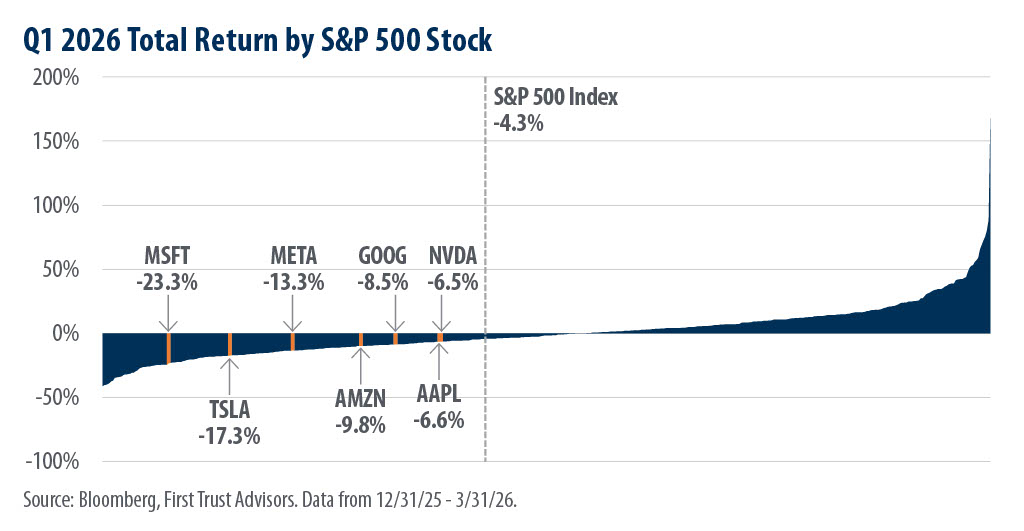
The S&P 500 declined –4.3% in the first quarter of 2026, but most of that decline came from just a handful of companies.
The “Magnificent 7,” which together represent roughly one-third of the Index, all posted negative returns during the quarter. Because the S&P 500 is weighted by company size, movements in these largest stocks can have an outsized impact on headline index results even when the majority of companies are performing differently.
In fact, 290 companies outperformed the Index during the quarter. If each stock in the S&P 500 had been weighted equally instead of by size, the Index would have gained about 0.7% rather than declining. This highlights how concentrated index construction can shape what investors see in market headlines.
Periods like this often reflect a shift toward broader participation across sectors, regions, and company sizes, an encouraging development after several years in which returns were driven primarily by a narrow group of mega-cap stocks.
Financial takeaway: Because the S&P 500 is heavily influenced by its largest companies, environments like the first quarter of 2026 help illustrate an important distinction: diversified portfolios are designed to capture returns from multiple sources rather than rely on a single segment of the market. When index performance is concentrated in just a few companies, diversified investors may experience results that differ meaningfully, and at times more favorably, than headline index returns alone might suggest.
📰🎧🍿What I’m Reading, Listening To, and Watching
📚 Long-Term Money (Morgan Housel)
A thoughtful reminder that as wealth grows, the goal often shifts from maximizing returns to preserving flexibility, resilience, and choice over time.
📊 The Upper Middle Class Trap (Nick Maggiulli)
An insightful look at how rising incomes can quietly raise expectations just as fast, making intentional spending decisions more important than ever.
🎯 Significance > Success (Ted Lamade)
A compelling reflection on how long-term fulfillment often comes less from achievement itself and more from how our efforts connect to something larger.
🌍 Layered Uncertainty: Conflict, Credit Stress, and AI (PIMCO)
A helpful overview of the multiple forces shaping today’s market environment, and why uncertainty rarely arrives one headline at a time.
📈 Flash Macro: U.S. Markets Update — April 2026 (KKR)
A concise snapshot of what institutional investors are watching right now across growth, inflation, and policy expectations.
🤖 When Will AI Be Both Powerful and Profitable? (Research Affiliates)
A useful perspective on the gap between technological progress and investment returns, and why the two don’t always move together.
🏡Behind the Scenes
Enjoying the Ride
Our family recently spent a day at Disneyland with a longtime friend, now affectionately known in our house as Uncle Nathan. I’ve known Nathan for more than 20 years, and he was a best man at our wedding. He invited us to join him for a day together in the park.
Our son had been to Disneyland once before, just before his third birthday. He remembered loving Astro Blasters and the Mad Tea Party. But now, a year older, taller, and more adventurous, we were interested to see what this visit might look like for him.
He’s naturally curious, but also cautious. He often enjoys riding a merry-go-round… as long as he can sit on a bench. Rides that leave the ground are still not his favorite. So before the trip, we spent some time watching ride previews together at home—especially classics like Pirates of the Caribbean and Haunted Mansion. Both are darker and more mysterious than anything he had tried before, and we weren’t sure how he would feel about them.
Watching the rides ahead of time made all the difference. We were able to find ride-through videos on YouTube and Disney+, which gave him a chance to see what the rides looked like, ask questions, and decide how he felt about them in advance. We reminded him that we would be right there with him the whole time—and that he didn’t have to ride anything he wasn’t comfortable with.
By the time the day arrived, those “unknown” rides had become something he was genuinely excited about. And sure enough, he loved them.
There was another milestone moment at Millennium Falcon: Smugglers Run, which has a 38-inch height requirement. He’s been getting more interested in Star Wars recently, so we were hoping he might make the cut. After being measured twice, right at the line, he was cleared to board. Just tall enough. It ended up being his favorite ride of the day.
Somewhere along the way, we also stopped to meet Mickey and Minnie, which made the whole experience feel even more special for all of us.
Looking back, what stood out most wasn’t just the rides themselves. It was watching how preparation changed his experience. Something that initially felt uncertain became something he could step into with confidence because he knew what to expect and knew he wouldn’t be facing it alone.
New opportunities often feel that way. With a little preparation, and the right people alongside us, they can become some of the most meaningful parts of the journey.
P.S. ~ Sometimes the biggest moments come when preparation helps us discover we’re “just tall enough” for what’s next—and ready to level up.




Are you overpaying taxes?
Take the 2-minute quiz to find out.
EXPLORE TOPICS


Start Your Next Chapter and Pursue Exciting Financial Goals
Click below and schedule a complimentary consultation
Similar Posts


Affinity Insider | October 2026
October 16, 2026
Affinity Insider | September 2026
September 22, 2026

Affinity Insider | August 2026
August 27, 2026
No results found.