Affinity Insider | January 2026

The start of a new year often brings a mix of clarity and pressure, reflection on what’s passed alongside questions about what deserves attention next.
In finances, as in life, meaningful progress rarely comes from trying to reset everything at once. It comes from slowing down just enough to identify what truly matters now, and creating the conditions that support thoughtful, steady decisions over time.
This edition of the Affinity Insider is about beginning the year with intention rather than urgency. It’s about revisiting priorities, staying grounded through the noise, and reconnecting decisions to a clear sense of purpose.
Here’s what you’ll find inside:
💸 Your Finances in Focus — A simple start-of-year reset, framed around a handful of questions designed to help prioritize where attention may matter most in 2026.
📈 Market & Investing Commentary — A look back at 2025’s strong returns and uncomfortable moments, and the enduring lessons they offer about volatility, diversification, and discipline.
🎁Featured Article — An exploration of why purpose should come before goals, and how a values-based approach, supported by a practical workbook, can create more durable progress over time.
📚 What I’m Reading, Watching & Listening To — Curated ideas on curiosity, patience, leadership, and long-term thinking.
❄️ Behind the Scenes — A winter family moment with snowballs flying, reminding us that meaningful experiences don’t need perfect conditions, just enough readiness to enjoy them.
Thank you for continuing to read, reflect, and engage alongside us as the year gets underway. We’re grateful to be part of how you think through decisions, priorities, and the seasons ahead.
Let’s begin.
💸Your Finances in Focus
A Simple Start-of-Year Financial Reset
The start of a new year naturally invites reflection, but effective planning isn’t about doing everything at once. It’s about identifying the few areas that deserve attention now, and building from there.
As we move into 2026, here are a handful of questions worth revisiting. You don’t need to answer “yes” to all of them. Often, clarity comes from recognizing which ones matter most this year:
- Cash Flow & Savings
Has your income or spending changed? Is your emergency fund where it needs to be? Are your savings rates still aligned with your goals? - Investments & Taxes
Does your portfolio still reflect your risk tolerance? Are there rebalancing, tax-loss harvesting, or Roth planning opportunities to be mindful of early in the year? - Benefits & Contributions
Are you taking full advantage of retirement accounts, HSAs, FSAs, or dependent care benefits? If you’re married, have you revisited spousal IRA options? - Life Events & Transitions
New job, growing family, upcoming move, or business change on the horizon? These moments often drive the most meaningful planning conversations. - Estate, Insurance & Protection
Is your estate plan current? Have beneficiary designations, insurance coverage, or fiduciary roles changed?
Think of this not as a checklist to complete, but as a lens to help prioritize thoughtful conversations and intentional decisions throughout the year.
If any of these questions spark a pause or a “we should probably look at that,” that’s often the perfect place to begin.
And, as always, we’re here to help connect the dots.
📈Market & Investing Commentary
2025 Market Recap: Strong Returns and Enduring Lessons
At a headline level, 2025 was a strong year for investors. U.S. stocks delivered their third consecutive year of double-digit gains, while international markets posted even stronger returns, reinforcing the value of global diversification.
What stood out about 2025 wasn’t the final result. It was the path along the way.
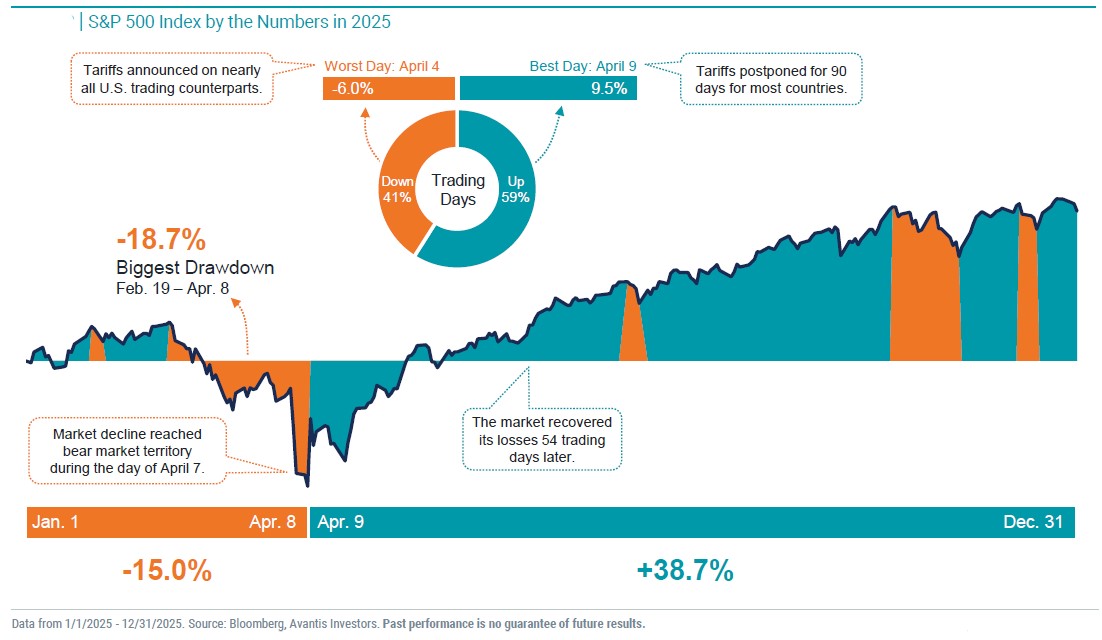
Markets experienced several pullbacks during the year, including a sharp decline in the spring tied to tariff announcements, shifting interest-rate expectations, and geopolitical uncertainty. At one point, U.S. stocks briefly approached what’s known as a bear market, a decline of 20% or more from a recent high, before recovering losses within weeks. While uncomfortable in real time, moves of this magnitude are well within historical norms. Temporary declines of 10–20% occur regularly, even in years that finish with strong results, and are a normal part of how markets generate long-term returns.
This combination of strong outcomes and uncomfortable paths is an important reminder: how markets feel is often very different from how they finish.
Key Takeaways from 2025
1. Volatility is not the same as risk
In early April, U.S. stocks briefly fell into bear-market territory, only to recover losses in less than two months. Investors who reacted emotionally risked missing one of the strongest rebound periods of the year. Those who stayed disciplined were rewarded.
2. Global diversification mattered, a lot
International stocks outperformed U.S. stocks by the widest margin since 1993. Particularly notable were international small-cap and value stocks, which ranked among the best-performing asset classes of the year. This reinforces why globally diversified portfolios remain a core building block of long-term plans.
3. Bonds regained their role
After several difficult years, bonds delivered meaningful returns in 2025. The Bloomberg U.S. Aggregate Bond Index gained more than 7%, supported by falling yields and Federal Reserve rate cuts. Bonds once again provided both income and ballast, a reminder of their role beyond short-term performance.
4. Headlines don’t dictate outcomes
From tariff escalations and AI concerns to geopolitical conflicts and political uncertainty, there was no shortage of reasons to worry. Yet markets advanced anyway, underscoring that long-term returns are driven more by participation and patience than prediction.
Risks to Watch Going Forward
Looking ahead, uncertainty hasn’t disappeared, it’s simply evolved.
- Inflation persistence: While inflation cooled, it remained uneven, complicating future rate decisions.
- Interest-rate sensitivity: Markets may continue to react sharply to changes in Fed policy expectations.
- Geopolitical and trade risk: Tariffs, elections, and global conflicts remain unpredictable.
- Concentration risk: Recent U.S. market leadership has been narrow, increasing the importance of diversification.
These risks are real but also well known, widely discussed, and already reflected in market prices.
Opportunities That Remain
Periods like this often create opportunity for disciplined investors:
- Rebalancing opportunities as leadership rotates across regions and styles
- Broader return drivers beyond U.S. mega-cap growth
- More attractive bond yields than investors have had access to for much of the last decade
- Long-term compounding for investors who avoid reactionary decisions
Markets tend to reward disciplined patience, while precision about future events remains an unreliable strategy..
Looking Ahead
As we look ahead, markets will continue to respond to familiar forces: economic growth, inflation trends, interest-rate policy, corporate earnings, and global events. Growth remains positive but uneven, inflation has moderated but not disappeared, and interest rates are lower than a year ago yet still elevated relative to the past decade. While recent earnings leadership has been concentrated among large U.S. companies, broader earnings expectations remain positive, and there are pockets of high-quality businesses trading at attractive valuations outside of mega-cap names. Geopolitical uncertainty is a constant in markets, not an exception, and is already accounted for in how portfolios are built, rather than something to react to as it arises.
As always, we remain focused on helping clients stay disciplined, diversified, and aligned with their long-term goals amid short-term market moves.

🎁Featured Article
Purpose Before Goals: A Better Way to Make Progress That Lasts
At certain moments—like a new year, a career change, or a shift in family life—it’s natural to pause and think about what’s next. But while fresh starts can spark motivation, they don’t always provide direction. Too often, goals are set quickly and pursued earnestly, only to lose momentum when life gets busy.
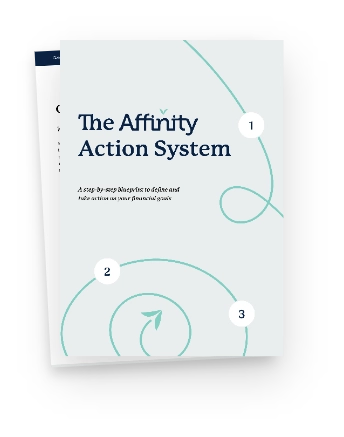
In this month’s featured article, we explore why clarity about what matters most should come before setting goals and how a purpose-first approach can lead to steadier, more meaningful progress over time. The article also introduces a practical resource, the Financial Purpose Workbook, designed to help turn reflection into clear, aligned action.
Inside the article, you’ll learn:
- Why fresh starts feel powerful, but often fall short on their own
- How values awareness creates clarity, agency, and confidence in decision-making
- Why sustainable progress depends more on systems than motivation
- Where traditional goal-setting (and even financial planning) can miss an important starting point
- How a clear sense of financial purpose can guide decisions through changing seasons of life
- How the Financial Purpose Workbook can help individuals and couples translate purpose into direction
Whether you’re reassessing priorities, navigating a transition, or simply looking for a calmer way to move forward, this article—and the accompanying workbook—offer a thoughtful framework for creating direction that holds over time.
Click here to read the full article.
Did You Know? 👇
While 2025 included sharp market swings, the overall pattern of the S&P 500 Index was well within historical norms.
- The largest drawdown was –18.7%. Declines of 10–20% occur regularly in equity markets, even in years that finish strong. This pullback was uncomfortable, but not unusual by historical standards.
- Big moves clustered together. The worst day (–6.0%) and best day (+9.5%) occurred within the same week, illustrating how quickly sentiment and markets can shift.
- Recoveries tend to be faster than declines. Despite the depth of the pullback, the market recovered its losses in just 54 trading days, a relatively quick rebound.
- More up days than down days. The market rose on 59% of trading days, which is modestly above the long-term average (typically closer to the mid-50% range).
- The long-term result dominated the short-term stress. After the April low, the market gained +38.7% through year-end. Investors who stayed the course through those trying times were likely rewarded.
Bottom line: 2025 is a good example of how normal volatility can feel dramatic in real time, even when long-term outcomes are positive. Staying invested through short-term moves mattered far more than reacting to them.
📰🎧🍿What I’m Reading, Listening To, and Watching
🤖 AI economic scenarios: revolutionary growth, or recessionary bubble? (Schroders) — A balanced look at how artificial intelligence could reshape productivity and profits, while also introducing new risks if expectations outpace reality.
❓The Curiosity Curve: A Leader’s Guide to Growth and Transformation Through Bold Questions (Clary Debra)— An exploration of how curiosity, asking better questions, and resisting certainty can unlock better leadership and long-term decision-making.
🧠 The Most Important Question of Your Life (Mark Manson)— A thoughtful reminder that the quality of our lives is often determined less by answers and more by the questions we choose to live by.
⏳ The False Timeliness of Life (Sahil Bloom) — A reflection on how urgency and comparison distort our sense of progress, and why patience and perspective matter more than perfect timing.
🏠 Is Home Equity Fake Wealth? (Nick Maggiuilli)— A clear-eyed take on when home equity meaningfully supports financial flexibility and when it’s more illusion than usable wealth.
🏡Behind the Scenes
Moments That Don’t Need Perfect Conditions
Over the holidays, we started introducing our son to a handful of old favorites and watching them together for the first time: Elf, Home Alone, The Grinch, and The Muppet Christmas Carol. A funny common thread ran through many of them, something we rarely experience in Southern California winters: snow. And, more importantly to a three-year-old, snowballs.
So as the new year approached and we prepared for a week in Colorado with family, just outside Denver in the mountain town of Evergreen, his anticipation steadily built. Along with excitement about time with Tutu and Tutu Mama (his names for his grandparents), he was focused on one big question: would there actually be snow?
The winter had been relatively warm by Colorado standards, and by the time we arrived, most of what had fallen days earlier had already begun to melt. But there was just enough left. Enough for him to stomp enthusiastically through every remaining patch, mittens on at every possible opportunity. Enough for him to “sneakily” gather a small pile of snow and launch a snowball at his grandfather. Enough for the rest of us to dish it right back. And enough for a walk around the lake, where the laughter from our impromptu snowball fight mattered far more than the thin patches of white underfoot. Watching his sheer excitement and wonder in those moments, it was clear the experience didn’t need to match the movie version to feel complete.
The week filled up with moments like that, including one evening before boarding the Georgetown Loop holiday train, a historic narrow-gauge railroad dressed up for winter with twinkling lights, decorated evergreens, and small holiday scenes tucked into the forest. Hot chocolate in hand, he watched as the cars filled, the lights flickered on, and the whistle signaled it was time to go. Sixty minutes later, we stepped back onto the platform having shared something simple, festive, and entirely present together.
Moments like these are instructive in their own way. Meaningful experiences rarely arrive fully formed or perfectly planned. They grow out of anticipation, adaptability, and presence. In family life and in long-term planning alike, it’s rarely about everything unfolding exactly as expected. It’s about being prepared enough to recognize the moment, and present enough to appreciate it when it arrives.
P.S. ~ As the year gets underway, it might be worth pausing on one small moment from the past month that really mattered. What does it tell you about what you want to protect or prioritize this year?


Are you overpaying taxes?
Take the 2-minute quiz to find out.
EXPLORE TOPICS


Start Your Next Chapter and Pursue Exciting Financial Goals
Click below and schedule a complimentary consultation
Similar Posts


Affinity Insider | October 2026
October 16, 2026
Affinity Insider | September 2026
September 22, 2026

Affinity Insider | August 2026
August 27, 2026
No results found.