When Your Company Goes Public, Start Here

Why the most important IPO decisions happen before the lockup clock starts, and how to think through the ones that don’t.
You’ve known this moment was coming. Maybe for months, maybe longer. And now that it’s here: the IPO date is set, the lockup period is real, and the number attached to your name in the cap table has suddenly become something you could actually spend. The question lands with real weight… what do I do with this?
What tends to follow is a rush toward tactics. Which shares should I sell first? How do I avoid AMT? Should I exercise my options now or wait? Can I shelter any of this from taxes?
Those are legitimate questions. I work through every one of them with clients. But jumping to them first is one of the most reliable ways to make a decision that looks smart on paper and feels wrong six months later.
The mechanics matter. The tax strategy matters. But they’re the third conversation, and most people try to start there.
Before the Numbers, the Noise
There’s a particular kind of pressure that builds in the weeks around an IPO. Colleagues are comparing notes. Advisors who found your company in an S-1 filing start showing up in your inbox with tax frameworks and option exercise calculators; their pitch built around fear of getting it wrong and the promise of a strategy that makes the anxiety go away. Family members who have never held a stock option have strong opinions about what you should do.
The noise almost always points the same direction: minimize your taxes, hold as long as you can, don’t leave money on the table.
Some of that advice is reasonable. Some of it will lead you somewhere you didn’t intend to go.
What I’ve found, working with clients through these moments, is that the people who navigate them with the most confidence aren’t the ones who walked away with the largest number. Nobody knows when the top is, and the opportunity cost of staying concentrated rarely shows up in the spreadsheet. The people who fare best are the ones who were clear, before the noise got loud, about what this liquidity was actually for.
That clarity is harder to find than it sounds. And it matters more than almost any tactical decision you’ll make.
What the Money Is For
I’ll often ask a client at the start of this process: if you sold a meaningful portion of your shares tomorrow, what would you do with the proceeds?
The question sounds simple. The answers are usually where the real planning begins.
For some people, the answer is concrete: a down payment on a home they’ve been waiting to buy, a college fund that isn’t where it needs to be, the ability to leave a job that no longer fits without the financial pressure that would normally make that impossible. Those people have an enormous advantage. When the goal is clear, the strategy follows naturally. You sell enough to fund what matters, you protect what you’ve built, and you decide what to do with the rest from a position of strength rather than anxiety.
For others, the answer is vaguer: financial independence, optionality, security. Those are real goals too, but they’re harder to act on without translating them into something more specific. What does financial independence actually require? What does security look like in dollar terms? The work of getting concrete about that is some of the most valuable work we do together, because it turns an abstract objective into a set of decisions with a clear rationale.
The point isn’t to arrive at the “right” answer to what the money is for. The point is to have an answer before the market starts moving and the pressure to act begins to build.
The Two Things That Pull Decisions Off Course
Even when someone has genuine clarity about their goals, two forces have a way of quietly rewriting the plan.
The first is the pull of the upside. The stock has been climbing. The company has real momentum. You’ve watched colleagues hold through volatility and come out ahead. Selling now feels like leaving money on the table, or worse, like a vote of no-confidence in something you’ve spent years helping build.
I understand that feeling. I’ve sat across from people who felt it acutely, people who had been at their company since the early days and felt their financial future and their professional identity pointing in the same direction: stay concentrated, stay committed.
But holding concentrated employer stock because it might keep going up is a thesis, not a plan. Post-IPO stock performance is genuinely unpredictable and the companies that have seen sharp declines in the 12 months after going public aren’t outliers. Belief in the company and prudent financial planning are not in conflict. They just belong in different parts of your decision.
Holding concentrated employer stock because it might keep going up is a thesis, not a plan.
The second force is subtler: a sense that selling is disloyal. That cashing out, even partially, is somehow a signal about how you really feel about the people you built this with, the mission you’ve been part of, the team that’s still in it.
That loyalty is real, and I’m not suggesting you ignore it. But your investment portfolio is not the right expression of it. You can be a genuine believer in what the company is building without concentrating your financial life on a single outcome. These are separate things, and conflating them tends to produce decisions driven by identity rather than intention.
Both of these forces operate beneath the surface of what looks like a financial choice. Naming them before you make any decisions is worth the time.
The Order That Actually Works
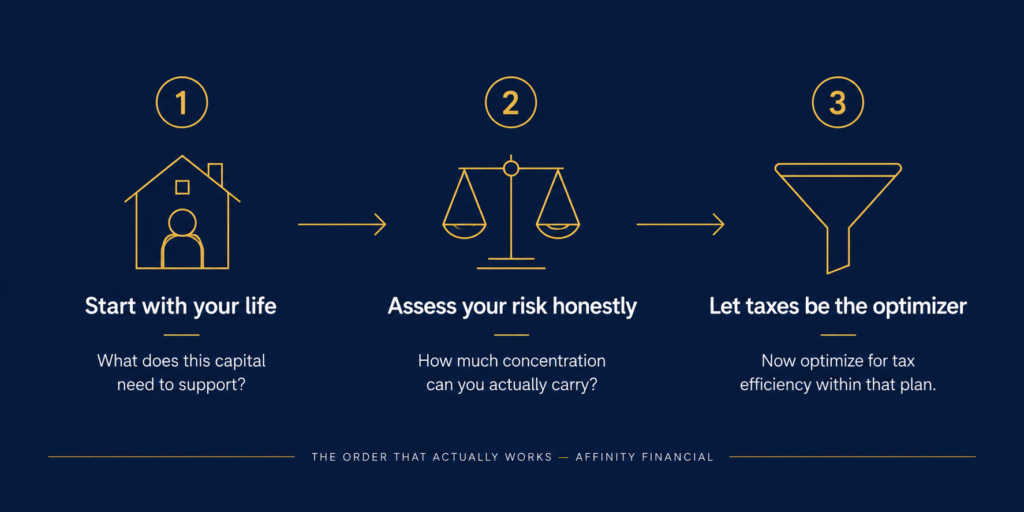
Once there’s some clarity on what the money is for and what forces might distort the decision, the framework is relatively straightforward, even when the execution isn’t.
1️⃣ Start with your life
Ask yourself:
- What do you need this capital to support?
- What flexibility do you want to preserve?
- What would you most regret not having protected if the stock declined materially before you could act?
2️⃣ Assess your risk honestly
Concentration risk isn’t just a portfolio concept, it’s a life concept. It shows up most acutely not when stock prices fall in the abstract, but when a single holding dominates the assets you could actually access and the decisions available to you narrow accordingly.
That means looking at your company stock not just as a percentage of your investment portfolio, but as a percentage of your liquid net worth. These are the assets that could reasonably be converted to cash without triggering consequences you’re not prepared for. That number is often more uncomfortable than the headline figure.
If you want to go deeper on what managing that exposure actually looks like in practice, from tiered de-risking to tax-smart diversification strategies, I’ve written about the full range of options here.
3️⃣ Let taxes be the optimizer
This is where the equity mechanics become essential:
- Whether you hold ISOs, NSOs, or RSUs shapes your tax exposure significantly
- QSBS status, if it applies, changes the calculus entirely
- AMT can arrive before you realize it’s coming
- Timing the sale of different share lots, coordinating with your tax professional, and building an execution plan that accounts for trading windows and lockup restrictions
All of that matters, and it requires real expertise to get right.
But taxes are the optimizer, not the foundation. Reversing that order is where most of the expensive mistakes happen.
The Planning That Happens Long Before the IPO
Here’s something most IPO content doesn’t say clearly enough: by the time the lockup expires, many of the most consequential decisions are already behind you.
The years leading up to a liquidity event are where equity compensation planning does its most important work, and where the difference between working with an advisor and not working with one tends to show up most clearly, even if the results aren’t visible until the IPO arrives.
- Early ISO exercises at low 409A valuations, before the company’s fair market value climbs, can dramatically reduce the tax cost of building a meaningful equity position
- Annual AMT modeling determines how many options can be exercised in a given year without triggering a tax liability on gains that haven’t been realized in cash
- NSO leverage, the relationship between exercise price and current fair market value, shapes when exercising makes economic sense and when it doesn’t
- 83(b) elections, filed within 30 days of an equity grant, can lock in favorable tax treatment that is simply unavailable later
- Tender offer windows, when they arise, represent one of the only opportunities to generate liquidity before a public market exists at all, and whether to participate, and how much, deserves more than a week of consideration
None of these decisions make headlines. None of them feel as consequential in the moment as watching your stock price tick up on the day of an IPO. But in aggregate, they often matter more than anything you can do once the lockup period begins.
For employees still in the pre-IPO window, many of these same disciplines like managing RSU withholding, coordinating vesting with your broader tax picture, avoiding the behavioral traps that come with equity-heavy compensation, apply right now, not just after the lockup lifts. I’ve written about that ongoing work in more depth here.
The clients I’ve worked with who were best positioned at the moment of a liquidity event weren’t the ones who called me when the IPO was announced. They were the ones who had been working through these questions for years, quietly, methodically, without the pressure of an imminent deadline forcing the pace.
If your company hasn’t gone public yet and you’re sitting on equity that could one day be significant, the best time to start this conversation is now. Not because the IPO is imminent, but because it doesn’t need to be.
What Good Decisions Actually Produce
One thing I try to be direct about with clients: there is no objectively correct answer here, and any advisor who suggests otherwise is oversimplifying.
Someone who sells early and diversifies will sometimes watch the stock triple afterward. Someone who holds through the lockup will sometimes watch it fall before they can act. Both outcomes are possible for any given company, and neither one tells you whether the decision was right.
Good IPO decisions rarely produce a guaranteed outcome. They produce a decision you can feel confident about regardless of what the market does.
What a sound decision-making process actually produces isn’t a guaranteed outcome. It produces a decision you can feel confident about regardless of what the market does because it was grounded in your goals, made with clear eyes about the risks, and executed with a plan that was built for your specific situation rather than borrowed from someone else’s.
That’s a different standard than maximizing the number. It’s also a more durable one.
The Conversation Worth Having Before the Window Opens
For clients navigating IPOs and liquidity events, I use a structured process to work through this, a way of organizing the thinking before the pressure to act gets loud. It covers the questions that matter before the tactical ones: what this capital is meant to support, how much risk you’re genuinely prepared to carry, where your decision-making might be distorted by forces that have nothing to do with your actual goals.
Only after that foundation is in place do we move into the mechanics: concentration targets, equity type analysis, tax modeling, and execution planning. That second layer requires professional guidance, and the stakes are often too high for guesswork or generalization.
If your company has recently gone public, or you’re watching a liquidity event take shape and want to think through it carefully before it arrives, I’d welcome the conversation. We’ll start with the right questions.
Everything else follows from there.
Disclaimer: This article is for general informational purposes only and is not intended to provide, and should not be relied on for, legal, tax, or accounting advice. Please consult a qualified estate planning attorney or tax advisor regarding your individual circumstances.
Derek Pantele, CFP®, CFA is the founder of Affinity Financial, a wealth advisory firm based in Orange, CA. He works with professionals and families navigating major financial decisions, including equity compensation, liquidity events, and long-term wealth planning.
Are you overpaying taxes?
Take the 2-minute quiz to find out.
EXPLORE TOPICS


Start Your Next Chapter and Pursue Exciting Financial Goals
Click below and schedule a complimentary consultation
Similar Posts


Open Enrollment 2027: A Practical, Tax-Savvy Guide to Maximizing Your Employer Benefits
October 12, 2026


The Home Search: Turning Vision Into Action
August 25, 2026


Before You Search: Defining What Home Means to You
September 29, 2026
No results found.