Before You Search: Defining What Home Means to You

Part 1 of a 3-Part Series: Buying a Home — A Planning Framework for One of Life’s Most Personal Decisions
My wife kept saying she wanted a home with charm.
The problem was that charm isn’t listed on Zillow.
You can’t filter for it. You can’t sort by it. And when I asked her to define it, the answers were real but hard to act on. Calm. Inviting. Walkable. A neighborhood where people actually cared about where they lived.
I think in frameworks and functions. So my instinct was to translate charm into something searchable — square footage, lot size, school ratings, commute time.
What I eventually learned was that the translation wasn’t the problem. The timing was.
We were trying to define what we wanted while simultaneously evaluating homes. And those are two very different activities. One is a planning exercise. The other is a shopping exercise. Conflating them is one of the most common and costly mistakes buyers make. Most people never separate them at all. We almost didn’t.
Before you can search well, you have to know what you’re searching for. Not in terms of bedrooms or price range, but in terms of the life you’re trying to build.
That’s where this story, and this series, begins.
Charm isn’t listed on Zillow. You can’t filter for it. You can’t sort by it.
The House Was Never the Point
Thirteen years ago, I bought a home as a single man. Affinity Financial didn’t exist yet. My wife, Stephanie, hadn’t entered my life.
A few years later, she did. That house became the setting for our first dates, our engagement, our wedding, the early years of building a business together, and the night we brought our son home from the hospital. It carried us through an entire chapter of life, and it did that extraordinarily well.
But it wasn’t a home we had chosen together.
When we began talking seriously about moving, with a second child on the way, dual work-from-home careers, and a growing need for space that actually matched our lives, something felt different about this decision.
This would be the first home we intentionally selected for the life we were building as a family.
That distinction led us to a question worth sitting with before any search begins, whether you’re buying your first home or your next one, and whether you’re navigating this decision alone or with a partner:
What is this home meant to support?
Not how many bedrooms. Not which neighborhood. Not what price range.
What kind of life?
Start With Reflection, Not Listings
Most people begin a home search by looking at homes. That’s understandable. Listings are immediate, visual, and easy to consume. But most buyers spend weeks evaluating properties before they’ve clearly defined what they’re actually looking for. Not in terms of features. In terms of purpose.
Why am I moving?
What do I want life to look like in ten or fifteen years?
What tradeoffs am I genuinely willing to make?
What would cause me to look back and say this move was worth it?
These questions don’t have obvious answers. But working through them, before you’ve fallen in love with a particular kitchen or a particular street, changes the quality of every decision that follows.
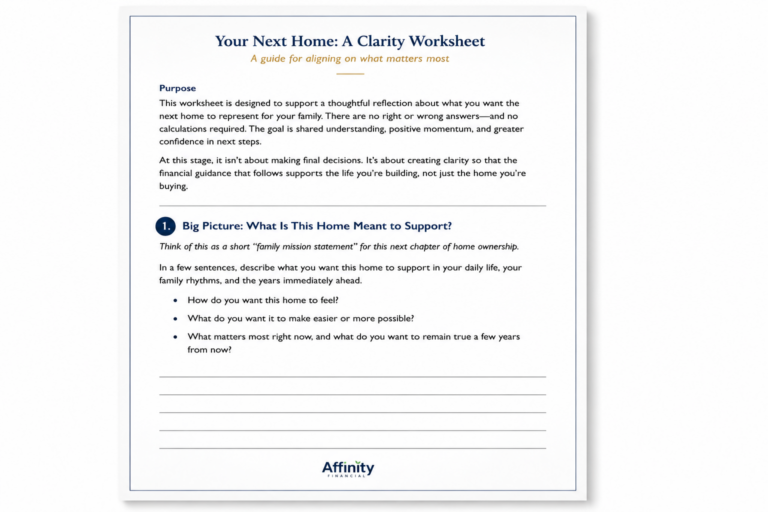
Before Stephanie and I started scheduling showings, we each completed a Home Clarity Worksheet independently, before comparing answers.
That sequencing matters. Completing the exercise separately, whether you’re doing it alone or with a partner, creates space for honest reflection before outside influences begin to shape the conversation. What you actually think has a better chance of surfacing before the pressure of a search begins.
Sometimes the worksheet surfaces more disagreement than alignment. That’s not a problem. It’s exactly the kind of information worth having before you start touring homes.
What we discovered, in our case, surprised us.
We were far more aligned than either of us expected. We both envisioned a long-term home, a 10-to-20-year decision, not a stepping stone. We both wanted dedicated space for two work-from-home professionals, room for a growing family, good schools, hosting capacity for family and friends, and a neighborhood where we could genuinely put down roots.
The worksheet didn’t tell us which house to buy. It helped us understand what we wanted the next chapter of our lives to look like.
Different Languages, Same Vision
One of the more interesting discoveries was that Stephanie and I often described the same priorities using completely different language.
I focused on function. How would we work from home? Would the floor plan support two separate workspaces? Would there be room for guests? How would the home serve our family through different stages of life over the next two decades?
Stephanie focused on how a home felt. Calm. Comfortable. Inviting. A neighborhood with genuine community feel.
And then there was charm, that word that kept surfacing and resisting easy definition.
We weren’t disagreeing. We were translating.
We weren’t disagreeing. We were translating.
As we spent weekends driving neighborhoods, attending open houses, and talking through what we’d seen, that feeling gradually became more specific. Charm started to look like mature trees and walkable streets. Established neighborhoods where homes had individual character. One-story living. A sense of pride and care you could see from the street before you ever stepped inside.
Meanwhile, my functional requirements became more nuanced. “We need office space” evolved into a clearer picture of how our family would actually move through a home on an ordinary Tuesday, where the kids would play while we were on calls, where guests would stay, how we’d host the gatherings we’d outgrown our current space for.
We weren’t evaluating homes yet. We were refining our vision.
And that refinement was doing important work that no listing search could have done for us.
Some Clarity Only Comes Through Experience
Here’s something the worksheet couldn’t have told us: neither of us initially described what eventually became some of our most important criteria.
Mature trees. One-story living. Individual character homes. Open streets. A neighborhood that felt earned rather than manufactured.
Those specifics didn’t exist on paper at the start. They emerged through experience, neighborhoods we drove and felt something in, homes we toured and immediately knew weren’t right, conversations afterward trying to articulate why.
This is worth saying directly, because it’s one of the places where buyers most often get stuck:
Clarity is not certainty.
Many people delay a search, or delay making an offer, because they feel they need complete confidence before moving forward. What arrives, if you pay attention, is gradually increasing clarity. And clarity improves through action, not deliberation alone.
We didn’t know which house we’d buy or which street we’d end up on. What we had was enough clarity to move forward with intention. And that was enough.
Going in, we assumed we wanted something largely move-in ready. One of the first homes we seriously considered required significant renovation and imagination. We didn’t buy it, but the experience confirmed something useful: we wanted to invest our energy in living in a home, not restoring one. That became a real criterion, not just an assumption.
Some priorities got stronger. Others became more flexible. Some tradeoffs we thought were unacceptable became worth discussing. Others became clear deal breakers.
The worksheet started the process. Experience refined it.
The Questions That Had Nothing to Do With Real Estate
Some of our most meaningful conversations during this period had very little to do with houses.
What kind of community do we want to be part of? What values do we want reinforced in daily life just by where we live? How much home is actually enough, not how much we could qualify for, but how much genuinely serves the life we’re building?
Those aren’t real estate questions. They’re life questions. And they belong in this conversation before the search begins.
Every buyer will answer them differently. The goal isn’t a particular set of values. It’s ensuring your values are actually present in the decision, rather than getting crowded out by square footage and list prices.
Affordability deserves the same intentionality. Most buyers can identify a maximum amount they’re capable of spending. But that number is rarely the right place to anchor the conversation.
The better question is: what level of home supports the life you’re trying to build while preserving the flexibility you value for everything else? Housing doesn’t exist in isolation. Every dollar committed to a mortgage is a dollar unavailable for something else, education, retirement, opportunity, margin for the unexpected.
That tension cuts both ways. The goal isn’t to spend as little as possible. Underinvesting in a home you’ll live in for fifteen years carries its own costs. The honest answer usually lives somewhere between stretching too far and playing it too safe, and it’s worth finding before you’re emotionally attached to a specific property.
If that number feels genuinely unclear, or if you and your partner aren’t yet aligned on what’s realistic, that’s not a reason to delay the vision work. It’s a reason to have a financial conversation before the search begins, not after.
From Vision to Action
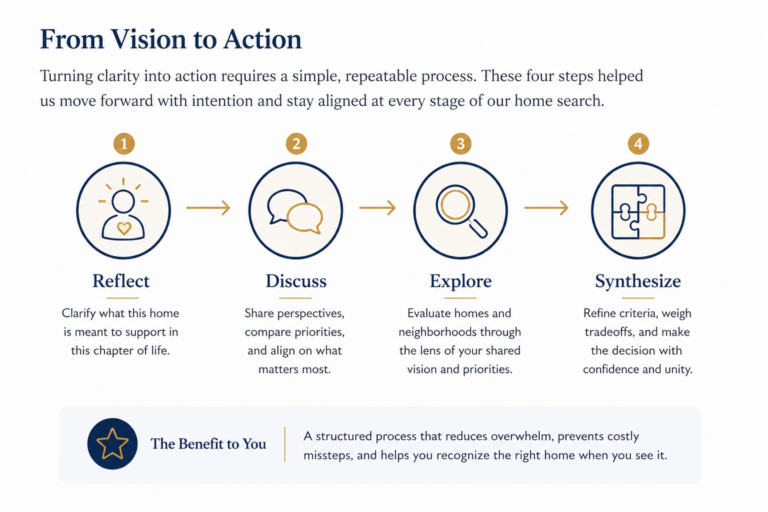
Looking back, the most important work happened before we ever submitted an offer.
What started as vague intentions became specific, actionable criteria:
“We want a forever home” became a clear, shared commitment to a 10-to-20-year decision, and all the intentionality that framing requires.
“We need more space” became a floor plan that supports two professionals working from home, accommodates guests, and gives a growing family room to live without constantly reorganizing around itself.
“We want charm” became a feeling translated into something observable: the kind of neighborhood you recognize before you ever step inside.
That translation, from feeling to criterion, from vague hope to shared language, is the real work of the pre-search phase. It doesn’t happen all at once. It happens through conversations, neighborhood drives, open houses, and the slow accumulation of knowing what feels right and being able to say why.
Once our conversations had produced enough shared clarity, I wrote it down. Not a wish list, but a concise buyer brief that captured our priorities, criteria, and what success actually looked like. We shared it with every real estate professional we considered working with. Every agent commented on it. How to build one, and how to use it, is the subject of Part 2.
Bringing It All Together
We gave ourselves three months. We found our home in about one.
I don’t think we got lucky. I think we moved quickly because the hard work was already done. We saw many good homes. We only made offers on a few. And when we walked through the home we ultimately purchased, we could picture our lives there, workdays and family dinners, birthdays and ordinary Tuesdays, the small accumulating moments that eventually become the story of a life.
The home isn’t perfect. No home is. Every home involves tradeoffs. The goal was never perfection. It was understanding which imperfections we were genuinely happy to live with.
By the time we made our offer, we weren’t really searching for a house anymore. We had already done the harder work of defining the life we hoped it would support.
The goal isn’t to find the perfect home. The goal is to develop enough clarity that you recognize the right home when you see it.
The goal isn’t to find the perfect home.
The goal is to develop enough clarity that you recognize the right home when you see it.
Start Here
If you’re considering a move, whether you’re a first-time buyer still figuring out where to begin, or someone who’s done this before and wants to be more intentional this time, start with the Home Clarity Worksheet before you open a listing or speak with a lender. The earlier in the process, the more valuable it becomes.
It’s designed to be completed individually first, then discussed. If you’re navigating this decision on your own, it works equally well as a structured way to surface your priorities before the noise of a search begins.
One of the first questions it asks: What is this home meant to support in your daily life, your family rhythms, and the years immediately ahead?
It’s a simple question. Most buyers never ask it. The answers it surfaces, and the conversations it creates, may prove more valuable than any home you tour.
Disclaimer: This article is for general informational purposes only and is not intended to provide, and should not be relied on for, legal, tax, or accounting advice. Please consult a qualified estate planning attorney or tax advisor regarding your individual circumstances.
Derek Pantele, CFP®, CFA is the founder of Affinity Financial, a wealth advisory firm based in Orange, CA. He works with professionals and families navigating major financial decisions, including equity compensation, liquidity events, and long-term wealth planning.
Are you overpaying taxes?
Take the 2-minute quiz to find out.
EXPLORE TOPICS


Start Your Next Chapter and Pursue Exciting Financial Goals
Click below and schedule a complimentary consultation
Similar Posts


Open Enrollment 2027: A Practical, Tax-Savvy Guide to Maximizing Your Employer Benefits
October 12, 2026


The Home Search: Turning Vision Into Action
August 25, 2026


When Your Company Goes Public, Start Here
June 18, 2026
No results found.