Affinity Insider | July 2026

We closed on our new house at the end of May and gave ourselves eight weeks to get it ready and move in by mid-July. The house needed more than we originally expected, starting with a full repipe inside and out. Just a few weeks after that work was done, we were surprised to find that water overflowed into the guest bathroom and kitchen, and my car window was shattered while parked on the street later that very same day.
The value of a plan isn’t that nothing goes wrong. It’s that when something does, the plan gives you room to respond instead of react. That’s as true in a home transition as it is in a portfolio or a retirement timeline, and it’s the lens I want to offer you this month.
This edition of the Affinity Insider is about staying steady when things don’t go the way you expected, whether that’s a market quarter that swung from turbulence to one of the strongest rebounds in years, a new savings account worth understanding before you fund it, or a house that hit its move-in date on paper but is still, box by box, becoming a home.
Here’s what you’ll find inside:
💸 Your Finances in Focus — What Trump Accounts actually are, the free money attached to them, and whether they’re worth prioritizing for your family.
📈 Market & Investing Commentary — A look back at one of the strongest quarters in years, and what a new Fed Chair means for the path ahead.
🎁Featured Article— The planning framework my wife and I used before we ever started touring homes.
📊 Did You Know? — What starting early actually saves you, in real numbers.
🏡Behind the Scenes — The full story of our move, the two disasters that hit on the same afternoon, and what it taught us about planning for what you can’t predict.
I count this newsletter among the things I’m grateful for each month, not because of what I get to share, but because of who’s on the other end reading it. I hope something in this edition earns the time you gave it.
Let’s begin.
💸Your Finances in Focus
What to Actually Do About Trump Accounts
Trump Accounts launched on July 4, and a fair number of clients have asked some version of the same question: should I open one for my kid? Here’s the short version.
What it is: A Trump Account, officially a 530A account, is a starter IRA for a minor. A parent or guardian opens it, money goes in until the year before the child turns 18, and then it converts into a traditional IRA the now-adult child controls. No earned income required. Investments are limited to a couple of low-cost index funds, and nothing can be withdrawn before age 18.
The free money is real, and it’s not just from you: Kids born 2025 through 2028 get a $1,000 federal seed contribution just for having the account opened and activated. Kids under 10 in lower-income ZIP codes may also qualify for a $250 grant from the Dell Foundation. Beyond that, contributions aren’t limited to parents: grandparents, other family, friends, and employers can all put money in, up to $5,000 per child per year combined. If you have family members looking for a meaningful gift idea, this is one.
The seed money isn’t the point, though: Morningstar modeled the outcomes, and a child who gets only the $1,000 seed and nothing else has a median projected balance of $0 by age 55, since small balances tend to get spent as soon as they’re accessible. A child who gets $5,000 a year in ongoing contributions has a median balance north of $3.9 million. The account isn’t the wealth. The habit of funding it is.
Should you fund it yourself? Opening it to capture the free money costs nothing but a few minutes. Funding it further is a real allocation decision, and it depends on what you’re already doing for your child. It can be a good fit if your 529 is already well funded or you’re running into Kiddie Tax friction on a UTMA. A 529 still wins if education is the priority or you want to keep control past age 18, and a plain custodial account still wins on flexibility.
Bottom line: Opening the account for the free money is close to a no-brainer for most families. Whether to make it a real savings priority is worth a conversation, not a headline.
If you want to talk through where it fits for your family, reply to this email, give us a call, or we can add it to the agenda for your next appointment.
📈Market & Investing Commentary
The Rebound Quarter
Markets delivered one of the strongest quarters in recent memory during the second quarter of 2026, with major U.S. indices posting their best returns since the 2020 post-pandemic rebound. This followed a more turbulent start to the year, a useful reminder that periods of uncertainty are often followed by recovery.
Market leadership also broadened significantly. While large technology and AI-related names again played a role, gains extended into small-cap, mid-cap, and international equities, several of which reached new record highs, reflecting a healthier and more durable market environment.
The most consequential development of the quarter took place at the Federal Reserve, where a new Chair was confirmed in May and quickly signaled a firmer commitment to bringing inflation back to target. Markets are still working through what this means for the pace of future rate policy. Corporate earnings, meanwhile, have been a bright spot, with growth and profit margins trending higher than expected, giving markets a fundamental tailwind even as questions about policy direction persist.
Not every asset class shared in the gains. Precious metals, after a strong multi-year run, saw a sharp pullback as investors took profits, a reminder that even long-term winners go through periods of consolidation, and that a diversified portfolio is built to weather this kind of dispersion.
Key Takeaways This Quarter
- U.S. and international equities posted some of their strongest quarterly gains in years, with leadership broadening well beyond large tech.
- A new Federal Reserve Chair introduced a more inflation-focused tone, adding uncertainty around the future pace of rate policy.
- Corporate earnings growth continued to exceed expectations, providing a fundamental underpinning to the rally.
As always, our focus remains on helping clients stay disciplined, diversified, and aligned with long-term goals amid short-term market movements.

🎁Featured Article
Before You Search: Defining What Home Means to You
Buying a home is one of the largest financial decisions most families will ever make. But the most important work rarely happens at the negotiating table. It happens before the search begins.
In this month’s featured article, we share the planning framework my wife and I used during our own home search, and the conversation we believe every buyer should have before the search begins.
Inside the article, you’ll learn:
- Why defining the life you want comes before evaluating the homes that might support it
- How to translate vague feelings like “charm” into specific, actionable criteria
- Why clarity and certainty are not the same thing, and why that distinction matters
- How affordability fits into the broader picture of the life you’re trying to build
- The tool we used to align our vision before we ever scheduled a showing
Whether you’re actively searching, just beginning to think about a move, or years away from making a decision, this article offers a practical framework for approaching one of life’s most personal decisions with greater intention and confidence.
Click here to read the full article.
Did You Know? 👇
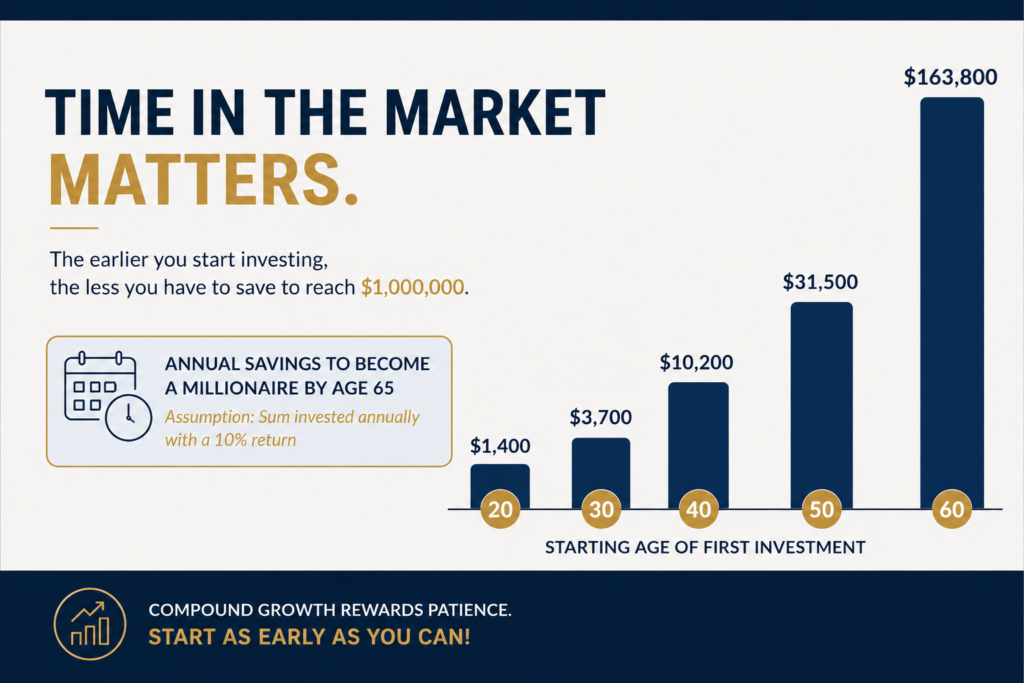
The earlier you start investing, the less you need to save each year to reach the same long-term goal.
- Starting at age 20 requires about $1,400 per year to reach $1 million by age 65 (assuming a 10% annual return).
- Waiting until age 40 increases that annual savings need to roughly $10,200, more than 7× as much.
- Delaying until age 60 means you’d need to save approximately $163,800 per year, highlighting the extraordinary value of compounding over time.
Financial takeaway: While no one can control market returns, everyone can control when they begin. Starting early allows time, not just savings, to do much of the heavy lifting toward long-term financial success.
📰🎧🍿What I’m Reading, Listening To, and Watching
📈 S&P 500 Index Earnings: Another Quarter of Massive Growth (First Trust)
Q2 earnings are running well ahead of expectations, up nearly 26% year over year, and the growth story has broadened well beyond the Mag 7 to the rest of the index.
⚽ The Maradona Theory of Interest Rates (The Macro Compass)
A case that the Fed’s next move is more theater than substance, talking hawkish and dovish in turns while rates stay put, with growth and inflation data too tame to justify the market’s hawkish tail risk.
💵 Are Stocks Going Up or Is the Dollar Going Down? (Of Dollars And Data)
A sharp rebuttal to the “currency debasement” narrative, showing that stock gains have far outpaced any reasonable measure of dollar erosion, which points to earnings growth as the real driver.
🎟️ Membership Has Its Privileges: Who Pays the Premium? (CFA Institute Research Foundation Series)
Rob Arnott digs into how simply joining a major index inflates a stock’s price, even when smaller, non-member companies are growing their fundamentals faster.
🔌 5:21 PM: The Order That Disabled Anthropic’s AI Models (Mauldin Economics)
A look at the Commerce Department’s export control order against Anthropic’s most advanced models as a preview of the deeper tension between AI capability and state control, a theme worth watching well beyond this one headline.
🏡Behind the Scenes
Turning a House Into a Home
When we closed on the new house on May 21, the plan was simple. Modernize a 1966 house for about eight weeks, move in mid-July, done.
Looking back, we’re still a little surprised we actually hit that target. Not because the target was wrong, but because of everything that tried to move it. Plumbers, electricians, painters, HVAC, insulation, fumigation, all cycling through the house. We were still living at our old place the entire time, so most days meant someone driving over to check on progress, make a decision, then driving back to a house we were simultaneously navigating routine life responsibilities.
Then came the day that really tested the timeline. A water overflow on brand new piping hit the bathroom and kitchen, triggering a dry-out process that took over the house for longer than we wanted. That same day, my car window was shattered while parked on the street. Two unrelated disasters, hours apart, on a day that started out completely ordinary. We laughed about it eventually, mostly because there wasn’t another reasonable option, and because getting through it together mattered more than either problem on its own.
The movers came right on schedule, a week ago now. Somewhere in the chaos of that day, we set our old queen mattress on our new king frame, stood back, and stared at it for a solid few seconds before realizing why it looked wrong. Eight weeks of planning, and the mattress size was something we forgot to think through.
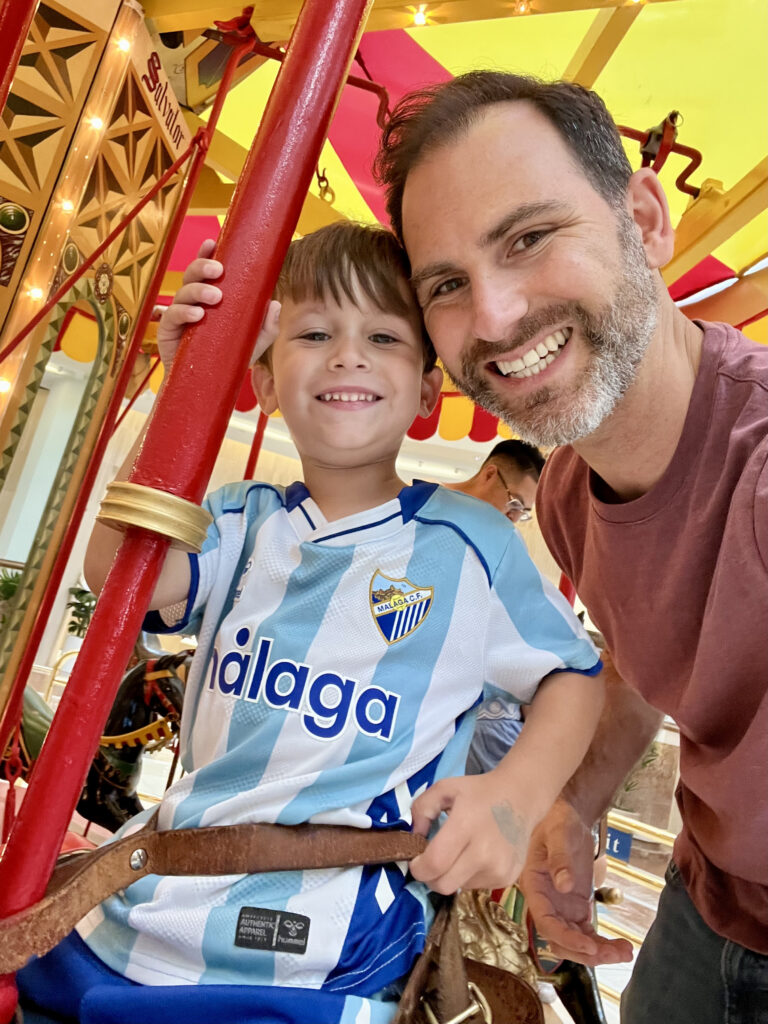
We hosted out-of-town family only days after that, because that’s the kind of home we wanted this to be from the start, work in progress or not. Our son has appointed himself to two jobs since we moved in. He’s part of the construction crew, which mostly means helping tighten screws and bolts on new furniture as we build it. And he’s part of the fire department, which mostly means hosing down the patio and the grass with great seriousness.
We’re not finished. Boxes are still waiting to be unpacked, more furniture is on its way, the walls need something on them besides paint, and the room set aside for our daughter arriving this fall still needs to become a true nursery. We’re also now prepping our old house to go on the market, which means the logistics aren’t over so much as they’ve changed shape. But one week in, this already feels less like the house we bought and more like the home we live in.
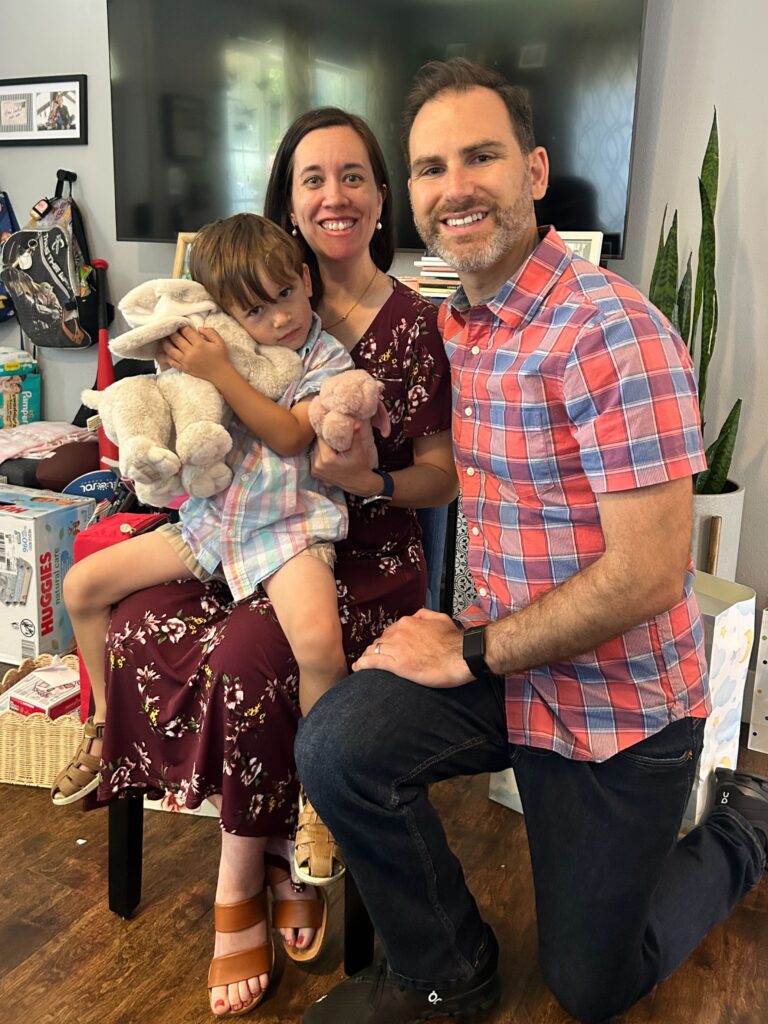
We didn’t do it alone. Stephanie and I made most of these decisions together, and both sets of parents showed up whenever we needed hands, patience, or just company while the house was loud with work.
Two things this season reinforced for us.
The first is about mindset. We had a plan and a target date, and we hit it, but not because nothing went wrong. We hit it because we kept adapting to what actually happened instead of insisting on what we’d expected to happen. Progress on something this big was never going to be a straight line. A good plan isn’t one that predicts everything. It’s one that can absorb what it didn’t.
The second is about money, and it’s the reason the first one was possible. This was an expensive stretch, planned and unplanned, spread across two properties at once. But because our saving and investing has been built around exactly this kind of season, none of it, not the plumbing surprise, not the shattered window, not the electrical retrofit, ever threatened the plan. That’s what a plan is actually for. Not to prevent the unexpected. To make sure the unexpected never becomes a crisis.
We’re grateful for where this is taking our family, one week in, still unfinished, and right on track anyway.
P.S. ~ Every big life transition requires some patience and perspective to get through. If you’ve got a story of your own, a move, a new chapter, a plan that didn’t go as expected, I’d love to hear it. Hit reply and tell me.

Are you overpaying taxes?
Take the 2-minute quiz to find out.
EXPLORE TOPICS


Start Your Next Chapter and Pursue Exciting Financial Goals
Click below and schedule a complimentary consultation
Similar Posts

Affinity Insider | October 2026
October 16, 2026
Affinity Insider | September 2026
September 22, 2026

Affinity Insider | August 2026
August 27, 2026
No results found.