Open Enrollment 2027: A Practical, Tax-Savvy Guide to Maximizing Your Employer Benefits

🍼 New Baby, New Benefits Math
This fall, our family grew by one. Our daughter arrived in September, three weeks ahead of schedule. She showed us right away that she’ll keep her own timeline, not ours.
The timing came with a twist. Just weeks earlier, our son traded his Montessori preschool for transitional kindergarten at the neighborhood school we had in mind when we moved across town this summer. For the first time in years, the monthly tuition line in our budget went quiet. It was a brief pause before we started touring infant daycares, and now that expense starts over in February.
Her early arrival also moved our benefits checklist up. A new baby opens a short window, often just 30 days, to add a dependent and adjust elections, and that clock started weeks before we expected.
If you’ve had children close together, you know this pattern. Each new stage changes the numbers: a preschool bill ends, after-school care begins, an infant program restarts the cycle. A budget that fit last year may not fit next year.
Open enrollment works the same way. Each fall, your employer gives you a short window to review your benefits and make choices for the year ahead. Open enrollment 2027 is no different: whether your household is growing, shrinking, or simply shifting, the right decision depends on who you are today, not who you were last year. Taking a few intentional minutes now can help ensure your benefits truly fit your current life, family, and goals for the year ahead.
✅ At a Glance: What to Review During Open Enrollment 2027
Here’s a quick overview of what to review, update, or optimize during your 2027 open enrollment period:
Plus, we address two non-employer open enrollment periods, ACA Marketplace and Medicare.
For a valuable checklist to better optimize your benefit elections, check out:
🍂 Why This Annual Pause Matters
It’s easy to breeze through and reselect last year’s defaults, but that approach can leave value and protection on the table.
Benefits make up nearly one-third of the average employee’s total compensation, and contribution limits adjust again for 2027. Last year’s tax law changes are now in place, so this is the year to make sure you’re actually using them.
This annual event isn’t just about picking insurance, it’s about aligning your hard-earned employer benefits with the life you’re living now. Maybe you are recently married, welcomed a new baby, changed jobs, moved states, became the primary income-earner, or experienced a health shift. Each transition changes what “good coverage” means for you.
🏥 Medical Insurance: Choosing the Right Plan for Healthcare Coverage and Tax Savings
Health insurance is one of the most valuable benefits offered by employers. It protects against unexpected medical costs and supports your ongoing physical and mental well-being.
What to Consider When Choosing a Medical Plan
- Your Healthcare Usage: How frequently do you visit doctors, specialists, or therapists?
- Prescription Needs: Do you have recurring medications that require certain coverage or tiers?
- Provider Preferences: Are your current doctors and specialists in-network?
- Financial Trade-Offs: Are you more comfortable with higher monthly premiums and lower out-of-pocket costs, or vice versa?
Common Plan Types
HMO (Health Maintenance Organization)
- Lower premiums and more predictable costs, but care is limited to a defined network of doctors and hospitals
- Requires choosing a primary care physician and getting referrals for specialists
- Best for those who prefer cost stability and don’t mind limited provider choice
PPO (Preferred Provider Organization)
- Higher premiums, but broad flexibility to see both in- and out-of-network providers
- No referral required for specialists
- Ideal for those with complex or ongoing health needs or preferred doctors outside narrow networks
EPO (Exclusive Provider Organization)
- Hybrid of HMO and PPO — no out-of-network coverage (except emergencies), but no referral requirement
- Usually lower cost than PPOs, with moderate flexibility
When comparing plans, don’t just compare premiums. Instead, consider the total potential cost: monthly premiums, deductibles, copays, coinsurance, and annual out-of-pocket maximums.
If you and a spouse both have separate employer health coverage options, compare coverage and total cost across both employers. This becomes especially important when factoring in dependents, as sometimes shifting coverage to one spouse’s plan yields better net value.
📌 Planning Tip: Focus first on health needs, then on cost for coverage
Pull last year’s claims summary and your current provider list; choose the plan that minimizes your realistic all-in cost (premium + out-of-pocket) while keeping key doctors in-network.
💳 How to Pay for Health Services: HSA, FSA, and HRA
If your health plan allows, you may be eligible for one or more tax-preferred accounts that help offset medical expenses.
Health Savings Account (HSA)
The Health Savings Account (HSA) is one of the most tax-advantaged tools available, and a frequent first step I recommend to W-2 clients who ask how to save on taxes.
Using an HSA for pre-tax savings requires enrollment in a High Deductible Health Plan (HDHP), so be aware of which health insurance coverages offer compatibility. By definition, an HDHP is a health plan with at least a $1,750 deductible for self-only coverage ($3,500 for family) and maximum out-of-pocket limit of $8,700 for self-only coverage ($17,400 for family). These plans typically have lower monthly premiums but higher upfront costs when you need care.
For those eligible to participate, the HSA offers a unique triple tax advantage:
- Contributions reduce taxable income
- Growth is tax-deferred
- Withdrawals for qualified medical expenses are completely tax-free
Better still, unused funds never expire and remain yours to invest and use in the future — even as a supplemental retirement account for healthcare costs later in life.
The contribution limit for 2027 is $4,500 if single or $9,000 for a family (up from $4,400 and $8,750 in 2026). Another $1,000 contribution is available for those age 55+.
For a family in the 32% federal tax bracket that contributes $9,000, they save about $2,900 in federal taxes and have the opportunity for tax-free healthcare withdrawals and investment growth.
Recent law changes also made more plans HSA-compatible, including bronze and catastrophic Marketplace plans, and allow certain direct primary care arrangements alongside an HSA.
📌 Planning Tip: Treat your HSA like a stealth retirement account
You don’t have to spend your HSA dollars immediately. Instead, consider investing them for long-term growth, much like you would in a 401(k) or IRA. As long as you save and document your qualified medical receipts, you can reimburse yourself months, years, or even decades later — completely tax-free. This approach allows your HSA balance to compound over time while keeping the flexibility to claim cash reimbursements whenever you choose. By paying current medical expenses out of pocket and letting your HSA investments grow, you can significantly increase the value of each tax-advantaged dollar, ideally using those funds later in life, when medical expenses are likely to be higher.
Flexible Spending Account (FSA)
A Flexible Spending Account (FSA) allows you to set aside pre-tax dollars for eligible healthcare expenses, reducing your taxable income in the process. Unlike an HSA, however, FSA funds generally must be used within the same plan year or they’re forfeited (some employers allow a small rollover or grace period). Because FSAs are owned by the employer, it’s important to spend down your balance before changing jobs.
As of this writing (October 12, 2026), the IRS has not yet released the official 2027 health FSA limit. Based on inflation trends, it is projected at roughly $3,450–$3,500 (up from $3,400 in 2026), with a carryover of about $690–$700 for plans that allow it. These figures are estimates, not final or official, and we’ll update this article once the IRS publishes them. FSAs can be a great fit for those who want additional tax savings.
Think of the FSA as a short-term tool: flexible, valuable, and best used annually for known or recurring expenses. Even for those with moderate or uncertain annual healthcare costs, it’s helpful to know that these accounts can be used to cover a surprisingly wide range of everyday expenses. This includes dental care, eyeglasses, contact lenses, over-the-counter medications, and even first-aid supplies. You can also use FSA funds for your spouse and dependent children, even if they’re not covered under the same health insurance plan.
🛒 Explore qualified expenses and eligible products here:
📌 Planning Tip: The Everyday Health Account
Even if you don’t have frequent doctor visits or prescriptions, your FSA can still go a long way toward everyday health and prevention. Eligible expenses include essentials like sunscreen, contact lens solution, over-the-counter pain relievers, and first-aid supplies — as well as dental cleanings, eye exams, or new glasses. Some self-care services, such as massages or acupuncture, may also qualify if prescribed by a healthcare provider for a medical condition (with a Letter of Medical Necessity). Think of your FSA as a pre-tax way to fund the wellness items and preventive care you already use throughout the year.
Health Reimbursement Arrangement (HRA)
Some employers fund a Health Reimbursement Arrangement (HRA) that can reimburse certain medical expenses or encourage preventive care. These are employer-funded only and less common than FSAs or HSAs. If offered, review the eligible expense list and use these funds first, since they’re not portable if you leave the company.
📌 Planning Tip: Use Employer-Funded HRA Dollars First
If your employer offers a Health Reimbursement Arrangement (HRA), treat those funds as “use first” dollars. Because HRAs are funded entirely by your employer and are not portable if you leave the company, it generally makes sense to spend from your HRA before dipping into your FSA or HSA. Use these funds for covered medical expenses or preventive care while preserving your personal, tax-advantaged savings for the future.
😁 Dental & Vision Coverage
Dental and vision insurance often deliver significant value at a relatively low cost, particularly for maintaining preventive care and avoiding large out-of-pocket surprises. These benefits don’t typically protect against catastrophic medical expenses, but they enhance quality of life, prevent small issues from becoming big ones, and keep your overall healthcare predictable.
Dental Insurance
Most plans cover preventive services such as cleanings, exams, and x-rays at little or no cost, with additional coverage tiers for fillings, crowns, and orthodontics. While major procedures can still carry higher out-of-pocket costs, routine care alone often makes the premiums worthwhile.
If your plan allows, consider scheduling treatments before year-end to use up any remaining annual benefit maximums.
Vision Insurance
Vision plans are ideal if you wear glasses or contacts, covering annual exams and offsetting lens or frame costs. Some plans even include discounts for laser vision correction or blue-light lens coatings. If you use screens frequently, these benefits can meaningfully support eye health and comfort.
📌 Planning Tip: Maintain Preventive Care, Evaluate True Value
If you regularly need cleanings, fillings, or corrective lenses, dental and vision plans tend to pay for themselves. However, if you rarely use these services, compare the total annual premiums with your likely out-of-pocket expenses and weigh whether the peace of mind and preventive value justify the cost.
👶 Dependent Care FSA (DCAP)
For those with young children, you may already be aware that the national average annual price of child care in 2025 was over $13,000. Expect roughly $10,000–$20,000 annually per child, depending on age and location.
The Dependent Care FSA is often a clear winner for families with children under the age of 13 or adult dependents, offering to lower out-of-pocket spending on eligible expenses like daycare, preschool, after-school care, summer day camps, and in-home care for dependents.
The annual contribution limit remains $7,500 per household ($3,750 if married filing separately) after last year’s permanent increase from $5,000. Note that this limit isn’t indexed for inflation, and both spouses must typically earn income to qualify.
If your care costs stop and restart during the year, size your election to the months care will actually happen, since funds can only reimburse expenses incurred. And if a baby arrives mid-year, you don’t have to wait for open enrollment since a birth is a qualifying life event that lets you start or increase contributions.
The Child and Dependent Care Tax Credit was also expanded under the One Big Beautiful Bill Act, but for most higher-earning households the pre-tax Dependent Care FSA still delivers the larger savings.
🛒 Explore eligible dependent care expenses here:
📌 Planning Tip: Using tax-free dollars means less expensive child care
A qualifying household in California could save as much as $3,775 in taxes by maxing out contributions in 2027.
❤️ Life Insurance
Life insurance offers lasting financial stability for the people who depend on you. The right amount of coverage can replace years of lost income, pay off debts, and fund major goals such as a child’s education or a spouse’s retirement.
Typical Employer-Sponsored Life Insurance Coverage
Basic Group Life Insurance
- Typically 1× salary or $50,000 (often employer-paid), but can be higher
Supplemental Group Life Insurance
- Additional optional insurance you can buy through payroll deduction, often without evidence of insurability up to a set cap
Spouse and Child Life Insurance
- Often available but limited and geared toward final expense protection
How Much Coverage Is Enough?
A common starting point is 10–30x annual income, though the right figure comes from a needs analysis that considers:
It almost always makes sense to accept the free or low-cost basic life insurance your employer provides.
Supplemental group coverage can also be a convenient, no-exam way to boost protection, particularly valuable if you have existing health issues that make private coverage costly or if you need additional insurance quickly.
However, relying solely on employer life insurance has clear limitations: coverage typically ends when you leave your job, premiums often increase with age, and benefit caps may fall short for higher earners. In contrast, a privately owned term life policy offers portability, stable premiums, and long-term control over both coverage and cost.
📌 Planning Tip: Build a Two-Layer Strategy
Take advantage of your employer’s free or low-cost coverage, then complete a needs analysis to determine if you should add a portable term policy. Locking in level premiums for 10–30 years while you’re young and healthy can secure long-term protection at a much lower cost.
💼 Disability Insurance
Your ability to earn income is your single most valuable asset. Disability insurance protects that income if an illness or injury keeps you from working.
Most people assume disability won’t happen to them; however, the odds are higher than most people think. According to the Social Security Administration, roughly 25% of today’s 20-year-olds will face a disabling condition before 67. Income protection isn’t optional, it’s foundational.
There are two major categories of disability insurance: Short-Term and Long-Term.
Short-Term Disability (STD)
- Typically covers 60–70% of income for 3 to 6 months
- Usually begins after using all paid time off (PTO) and a brief waiting period (7–14 days)
Long-Term Disability (LTD)
- Extends income protection for years, often until retirement age
- Usually starts after a 90–180 day elimination period (when short-term coverage ends)
What to Consider When Choosing Disability Insurance
- Who Pays the Premium
- If employer-paid, income benefits are fully taxable
- If employee-paid with after-tax dollars, income benefits are tax-free
- Definition of Disability
- “Own occupation” coverage pays if you can’t perform your specific job, while “Any occupation” is stricter and may not pay unless you can’t work at all
- Often, employer-sponsored disability policies switch the definition from “own occupation” to “any occupation” after a pre-determined period of time, typically 2 years
- Coverage Adequacy
- Definition of “covered earnings”: Many group policies base benefits on base salary only (excluding bonus, commission, or RSU income). High variable compensation may require a supplemental individual policy
- Monthly income benefit dollar caps: Even with a 60% formula, a benefit cap (e.g., $10k per month) can lower the true replacement rate for higher incomes
- Elimination Period
- Also known as the waiting period, this represents how many days, weeks, or months you must be disabled before any income benefits are paid out
- For planning, aim to match this period with your emergency cash reserves (e.g., a 90-day elimination period pairs with ~3 months of expenses)
📌 Planning Tip: Right-size your income protection
Aim to replace about 60–70% of your total income if the benefit is tax-free, or a similar take-home equivalent after accounting for taxes and policy caps. Consider a supplemental policy if bonuses or commissions aren’t covered under your employer plan. And be sure your emergency fund aligns with your elimination period. For example, six months of expenses for a 180-day waiting period.
🧘 Other Common Employer Perks
During open enrollment, take a moment to review the “hidden value” benefits your employer may offer. These often go overlooked but can meaningfully improve your financial, family, and personal well-being.
Family & Lifestyle Benefits
Financial & Workplace Perks
And while open enrollment doesn’t lock in retirement choices, it’s a great time to confirm you’re on track for meeting the current year’s retirement strategy. This may include contributing enough to receive the full employer match, maxing out annual pre-tax or Roth salary deferrals, or funding a Mega Backdoor Roth through after-tax contributions. If you’re 60–63, an enhanced “super catch-up” lets you save even more. And if your prior-year wages exceeded the IRS threshold (roughly $150,000, indexed), your catch-up contributions must now go in as Roth rather than pre-tax.
📌 Planning Tip: Optimize with a team approach
If both spouses work, coordinate elections to avoid overlapping coverage and make the most of complementary household benefits.
🚫 Avoiding Missed Opportunities
Over years of working with professionals, here are the most common benefits left untapped:
- Not contributing enough to capture the full 401(k) match or hit full salary deferral limits, including age 50+ and age 60–63 catch-ups
- Overlooking tax-free investment growth within Health Savings Accounts (HSAs)
- Outright skipping or leaving major gaps in long-term disability coverage
- Forgetting to review and update beneficiary designations
- Under-contributing to FSA health care because of uncertain future medical expenses
- Paying for childcare with post-tax dollars instead of a pre-tax Dependent Care FSA
- Failing to compare spouse’s open enrollment options side-by-side
🌎 Two Other Non-Employer Open Enrollment Periods to Know
ACA Marketplace (Individual Coverage)
If you don’t have access to employer-sponsored health insurance — whether you’re self-employed, between jobs, or retiring early — you can obtain coverage through the Affordable Care Act (ACA) Marketplace. Open Enrollment for 2027 coverage is shorter this year: November 1 through December 15, 2026 in states using HealthCare.gov. State-run exchanges may extend their deadline, but no later than December 31 (Covered California runs through December 31). All plans chosen during open enrollment now start January 1. The February 1 start option is gone.
Marketplace plans are organized into four “metal” tiers: Bronze, Silver, Gold, and Platinum. Each slightly differs in how costs are shared between you and the insurer. It’s a common misconception that higher-tier plans automatically provide “better” coverage. In truth, the right plan depends on your expected medical usage and cash flow preferences:
- Bronze plans typically have the lowest monthly premiums but higher deductibles and out-of-pocket costs when care is needed, ideal for healthy households that use few services and want access to HSA-eligible savings
- Silver plans balance monthly premiums and out-of-pocket costs and often qualify for cost-sharing reductions if you’re eligible for income-based subsidies
- Gold and Platinum plans feature higher monthly premiums but lower deductibles and copays, helpful if you anticipate significant or ongoing medical care, but not always the best value if your healthcare usage is modest
The enhanced premium tax credits expired at the end of 2025, and the “subsidy cliff” is back. Households with income above 400% of the federal poverty level generally receive no premium assistance, and crossing that line by even a few dollars can mean thousands in lost subsidies. If you’re retiring early, between jobs, or self-employed, managing your 2027 income (through Roth conversions, capital gains timing, or retirement contributions) can be worth more than any plan choice.
Explore 2027 options at HealthCare.gov or your state ACA Marketplace site.
📌 Planning Tip: Plan Your Income, Then Your Plan
Project your 2027 income before you shop. Staying under the 400% FPL threshold may preserve meaningful subsidies, and if you're above it, a bronze HSA-eligible plan paired with HSA contributions may offer the best total value.
Medicare Open Enrollment
If you’re enrolled in Medicare, your annual Open Enrollment window runs from October 15 through December 7, 2026, for coverage beginning January 1, 2027.
This period applies primarily to those who wish to make changes to their Medicare coverage, such as switching between Original Medicare and Medicare Advantage or reviewing their Part D prescription drug plan. Even if you’re satisfied with your current setup, it’s wise to review your plan annually since premiums, provider networks, and drug formularies can change each year.
This is your annual opportunity to:
- Switch from Original Medicare to a Medicare Advantage Plan (or vice versa)
- Change your Medicare Advantage Plan to a different provider or plan type
- Add, drop, or change your Part D prescription drug plan
- Review supplemental coverage (Medigap) if you’re coordinating between Original Medicare and private secondary insurance
- Ensure your providers and medications remain in-network
For those on Original Medicare with a Medigap policy who are not changing their coverage, you generally don’t need to take action during Open Enrollment, but it’s still a good time to verify that your prescription plan and providers remain aligned with your needs for the year ahead.
Explore plans and compare options at Medicare.gov or consult a trusted Medicare specialist, such as Boomer Benefits, for personalized support.
📌 Planning Tip: Verify, Don’t Assume
Each fall, review your plan’s Annual Notice of Change (ANOC) and check your medications, providers, and premiums against current options. Even satisfied participants should review options, as coverage details and costs shift each year and small adjustments can lead to meaningful savings or better coverage.
🧩 Putting the Pieces in Place
Clients often ask: “What can I do to save more on taxes and protect my wealth?”
One of the simplest and most effective answers is to maximize your tax-advantaged employer benefits. Each dollar contributed to an HSA, FSA, or dependent care account can directly reduce your taxable income while protecting your health, income, and family along the way.
Open enrollment isn’t just an HR formality. It’s a built-in checkpoint to realign your well-deserved benefits with your current goals and season of life.
With 2027 bringing higher HSA limits, a permanently larger Dependent Care FSA, and a tighter ACA enrollment window, thoughtful benefit choices can meaningfully strengthen your financial foundation and pay dividends all year long.
📅 Ready to Maximize Your 2027 Benefits?
If you’d like to take a more strategic approach this year:
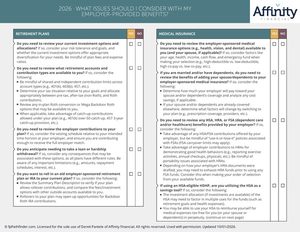
- ✅ Utilize our interactive checklist, “What Issues Should I Consider With My Employer-Provided Benefits?”
- 📤 Upload your 2027 benefits package for review
- 📅 Schedule a Max My Employer Benefits Meeting
Your benefits are more than a few workplace forms, they’re a cornerstone of your financial plan. Let’s make sure they work as hard for you as you do for them.
Disclaimer: This article is for general informational purposes only and is not intended to provide, and should not be relied on for, legal, tax, or accounting advice. Please consult a qualified attorney or tax advisor regarding your individual circumstances.
Are you overpaying taxes?
Take the 2-minute quiz to find out.
EXPLORE TOPICS


Start Your Next Chapter and Pursue Exciting Financial Goals
Click below and schedule a complimentary consultation
Similar Posts


The Home Search: Turning Vision Into Action
August 25, 2026


Before You Search: Defining What Home Means to You
September 29, 2026


When Your Company Goes Public, Start Here
June 18, 2026
No results found.