Affinity Insider | October 2026

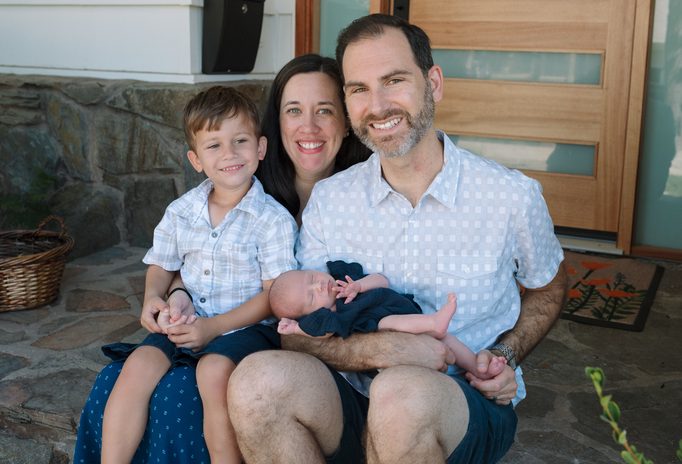
When I look back over the past year, nearly everything around me has grown. The business has grown. The accounts we manage together have grown. Our family has grown from three to four. And I hope, in the ways that don’t show up on any statement, we’ve all grown a little too: more patient, more prepared, a bit closer to the people we’re trying to become.
Growth is often the goal, but it also changes what your plan needs to do. A bigger family needs different protection. A bigger portfolio needs a steadier foundation. And a fuller life needs a plan that gets revisited, not just renewed.
This edition of the Affinity Insider is about growth and keeping your plan in step with it, whether that’s a benefits election that should look different from last year’s, bonds that keep a growing portfolio steady, or a family finding its new rhythm.
Here’s what you’ll find inside:
💸 Your Finances in Focus — The 2027 open enrollment changes worth a fresh look, and why reselecting last year’s elections can leave money on the table.
📈 Market & Investing Commentary — A quarter when stocks paused near record highs and bonds reset, and what higher yields mean from here.
🎁 Featured Article — Why own bonds when stocks are setting records, and how to tell whether yours are doing the job you need.
📊 Did You Know? — Whether the party in control of Washington actually changes your returns, according to 155 years of market history.
👶 Behind the Scenes — One month with our daughter, how all four of us are growing ounce by ounce, and a big brother with a brand-new vocabulary.
Affinity Financial recently reached 100 client households. Each one represents a family that trusts us with something important. Whether you’re one of them or simply reading along, thank you for being part of the story.
Let’s begin.
💸Your Finances in Focus
Open Enrollment 2027: Make Your Benefits Fit This Year
Our family’s benefits checklist looks nothing like last year’s. A new baby, a son starting TK, and a daycare bill that restarts in February all changed what “good coverage” means for us.
Open enrollment is your yearly chance to make those changes. Most people reselect last year’s elections and move on. A few intentional minutes can mean real tax savings and better protection for the year ahead.
Here’s what stands out for 2027:
- Higher HSA limits: Families can contribute $9,000, and more health plans now qualify as HSA-eligible.
- A larger Dependent Care FSA, for good: The $7,500 household limit is now permanent. If your care costs stop and start during the year, how you size your election matters.
- A shorter ACA window: Marketplace enrollment ends December 15 in most states, and the subsidy cliff is back for higher earners.
- Retirement rules worth a second look: Savers ages 60–63 get a larger catch-up, and higher earners must now make catch-up contributions as Roth.
The full guide covers each benefit, from choosing a health plan to closing gaps in disability coverage, with planning tips for couples comparing two employers’ options.
👉 Read the guide: Open Enrollment 2027: A Practical, Tax-Savvy Guide to Maximizing Your Employer Benefits
Your family will change, and your benefits should keep up.
📈Market & Investing Commentary
Q3 2026: Stocks Pause, Bonds Reset
After an exceptionally strong second quarter, markets took a breather in the third quarter of 2026. The S&P 500 gained roughly 2%, reaching new record highs in August before giving back some ground in September, and remains up nearly 12% for the year.
Market leadership narrowed again. Gains were concentrated in large technology and AI-related companies, along with energy stocks lifted by higher oil prices, while small-cap stocks fell more than 7% and most sectors finished lower. It’s a reminder of why we build portfolios around a range of outcomes rather than a single index or theme.
The bigger story was in bonds. Renewed conflict in the Middle East pushed oil prices up roughly 30%, reviving inflation concerns, and the Federal Reserve raised rates in September for the first time since 2023. The 10-year Treasury yield climbed to about 5.3%, and the broad bond market declined about 3.5%. The silver lining: high-quality bonds and cash now offer some of the most attractive income in years.
Since quarter end, the tone has improved. Stocks returned to record highs in early October as oil prices cooled, and expectations for another near-term Fed hike have faded. Bond yields remain elevated, but strong demand at recent Treasury auctions suggests investors increasingly see today’s yields as an opportunity.
Corporate earnings remain the market’s foundation, with S&P 500 earnings growth expected near 29%, a third straight quarter above 25%.
Key Takeaways This Quarter
- U.S. large-cap stocks posted modest gains and new record highs, but leadership narrowed while small caps declined
- Higher oil prices and firmer inflation led the Fed to raise rates, pushing 10-year Treasury yields to about 5.3%
- Bonds declined as yields rose, but higher yields create stronger income opportunities going forward
As always, our focus remains on helping clients stay disciplined, diversified, and aligned with long-term goals amid short-term market movements.

🎁Featured Article
Why Own Bonds: Income and Ballast for Your Portfolio
When stocks are setting records and bonds barely move, it’s natural to wonder why you own them. But bonds were never meant to be the growth engine. Their job is to keep the rest of your plan steady when markets aren’t.
In this month’s featured article, we explain what bonds actually do in a portfolio, how they work from the lender’s side of the table, and why the right bonds depend as much on your tax bracket as on your goals.
Inside the article, you’ll find:
- The four jobs bonds do, and why a quiet year doesn’t mean they’ve failed
- Why the yield you start with matters more than last year’s return
- How retirees can set aside years of spending so a market decline never forces a sale
- Why the same municipal bond can be a big win for one household and a wash for another
- Four questions to ask about the bonds you own today
Whether you’re building wealth, preparing for retirement, or already drawing from your portfolio, this guide offers a practical framework for owning bonds with clear purpose and realistic expectations.
Click here to read the full article.
Did You Know? 👇
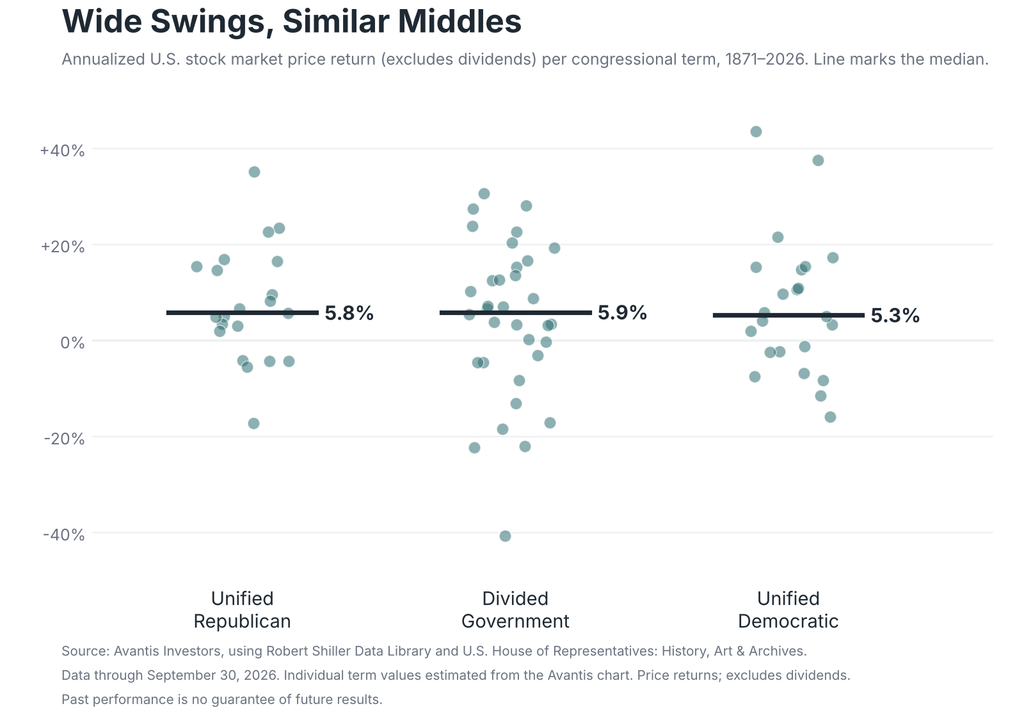
Since 1871, the party in control of Washington has made almost no difference to the stock market’s typical return.
- The medians are nearly identical. Looking at U.S. stock returns during every congressional term since 1871, the median annual return was 5.8% under unified Republican control, 5.9% under divided government, and 5.3% under unified Democratic control. Across 155 years, the spread between the three is 0.6 percentage points.
- These are price returns only. Dividends aren’t included. Historically they have added several percentage points a year, so investors who reinvested them earned meaningfully more than these figures show.
- Every arrangement has had good terms and bad ones. Each configuration includes stretches of strong gains and stretches of real losses. The outcome of any single term has varied far more than the outcome by party.
- Other forces carry more weight. Starting valuations and corporate profitability have done more to drive returns than the makeup of Washington.
Financial takeaway: Elections can change policy, and policy can matter for specific parts of your plan, such as taxes. But a long-term portfolio built around who wins in November is a bet on a factor that history says hasn’t been decisive. The more reliable choice is to make decisions you’d be comfortable with no matter which way the results go.
Source: Avantis Investors, using the Robert Shiller Data Library and U.S. House of Representatives: History, Art & Archives, 1871 through September 30, 2026. Returns are annualized U.S. stock market price returns by congressional term and exclude dividends. Past performance is no guarantee of future results.
📰🎧🍿What I’m Reading, Listening To, and Watching
😊 The Art of True Happiness | Dr. Arthur Brooks: Arthur Brooks breaks happiness into three “macronutrients” (enjoyment, satisfaction, and meaning) and explains why high achievers and new retirees often struggle most with the second.
📖 Living An Analog Life: In a guest post on The Retirement Manifesto, The Retired Alchemist makes a quiet case for real books, pen and paper, cooking from scratch, and leaving the phone at home. Her goal is to get back the sense of “time expanse” that years of rushing take away.
🧑🎓 The Kids Are Alright: What the Data Actually Says About Young People and Money: BCG’s economists show that Gen Z is out-earning every prior generation at the same age, and that Millennials pulled ahead on wealth by 32. They argue the path to prosperity is now later and less linear, but it isn’t broken. The real gap is expectations: Gen Z says it needs a $600,000 salary to feel successful.
🌧️ What If This Turns Out to Be a Terrible Time to Retire?: Christine Benz explains why retiring near a market peak is a sequence-of-returns problem. She offers four practical ways to blunt it: phase into retirement, hold a cash-and-bond buffer, keep distinct holdings to rebalance from, and flex spending in down years.
🤖 ChatGPT and Claude get financial advice wrong 57% of the time, potentially costing tens of thousands of pounds: A UK study tested 18 popular AI models on 121 money questions. The models got more than half wrong, and nearly 9 in 10 of the harder ones, through miscalculations, missing risk warnings, and invented rules.
💼 The Optics of Low-Hire, Low-Fire: Ed D’Agostino looks past the 4.1% unemployment rate to a labor force that has almost stopped growing. That leaves productivity, not new workers, to carry future growth.
🏡Behind the Scenes
Ounce by Ounce
Our daughter turned one month old this week, and she’s crushing the only three goals she’s set for herself: eat, sleep, and keep the diaper supply moving. She arrived at just five pounds and is now around eight, filling out her clothes nicely. Stephanie’s recovery has gone well too, which we don’t take for granted.
She isn’t the only one growing. Our son has taken on the big brother role with what I can only describe as aggressive gentleness. He’s always ready with another hug or kiss, and we spend a good part of each day reminding him how small she is. His one complaint is the volume. When she cries, he plugs his ears and carries on.
We’ve grown too. When our son was born, life split into a clear Before and After. Everything was new, from the daily rhythm to learning how to care for a newborn at all. This time feels more like an evolution than an upheaval. Sleep is still at a premium, but Stephanie and I came in confident we could handle it and that we could talk through the hard moments together. It’s something I see in my work too: big transitions feel a lot less daunting when you’ve prepared for them and trust the people navigating them with you.
Of course, a big brother’s needs don’t pause for a newborn. We’ve made a point of giving him quality time with lots of crafts, playdates with friends, and baking banana chocolate chip muffins and pizza with his grandmother. A dad-and-son dinner at Chick-fil-A also left him with a new (hopefully short-lived) habit, picked up from a newfound best friend in the play area: ending sentences with a sassy “bro.” We’ve explained that Mom, Dad, and his sister are not his “bro.” Ollie the cat, however, is fair game.
One month in, she’s growing, and so are we: ounce by ounce, hug by hug, and one short night at a time.
P.S. ~ Our son wanted me to add one thing: “She’s still too loud, bro.”


Are you overpaying taxes?
Take the 2-minute quiz to find out.
EXPLORE TOPICS


Start Your Next Chapter and Pursue Exciting Financial Goals
Click below and schedule a complimentary consultation
Similar Posts

Affinity Insider | September 2026
September 22, 2026

Affinity Insider | August 2026
August 27, 2026
Affinity Insider | July 2026
July 28, 2026
No results found.