Affinity Insider | September 2026

Our daughter arrived on September 9th, three weeks early. She’s small and growing, her big brother is smitten, and Stephanie is recovering well. We’re home, all four of us, and grateful to the people who got us here.
We were wrong about the date by three weeks, and it barely mattered. Under pressure you find out quickly which preparations are load-bearing and which are just pleasant to have underway.
This edition of the Affinity Insider is about the difference between timing you can’t control and sequence you can. Good planning doesn’t buy certainty. What it buys is the freedom to be present for the moment you’ve been preparing for — a new baby, a new job, or a market doing something nobody saw coming. The work you do beforehand is what lets you meet it calmly.
Here’s what you’ll find inside:
💸 Your Finances in Focus — Why a job change puts more of your plan in play than your paycheck, and which pieces have a window that closes before you notice.
📈 Market & Investing Commentary — The Fed’s first rate increase since 2023, and why the rates it doesn’t set were already moving.
🎁 Featured Article — The planning sequence I walk through with expecting parents, sorted by what has a window and what can wait.
📊 Did You Know? — How last year’s best and worst developed stock markets ended up 96 percentage points apart, both of them in Europe.
👶 Behind the Scenes — The story of the night our daughter arrived and my son’s reaction to the news.
This newsletter has been a blessing, a way to share professional insight and personal news with people I’m genuinely glad to know. It’s an honor to do this work.
Let’s begin.
💸Your Finances in Focus
A New Job Changes More Than Your Paycheck
A job transition is rarely just an income change. It resets several parts of the plan at once, and it usually arrives when your attention is on the work ahead rather than the details behind you.
When clients change roles, we’re looking well beyond the new salary. We’re reviewing tax withholding, 401(k) contribution limits, employer match timing, HSA eligibility, health insurance, disability and life coverage, old retirement accounts, equity compensation, and cash reserves.
A few details matter more than people expect.
- Money already earned: A bonus that pays after your last day. A retirement plan match still short of vesting. Unvested options that disappear the moment you go.
- Timing that nobody coordinates: Your new employer has no idea what you contributed to your prior 401(k). The annual deferral limit applies to you, not to each plan, which creates either over-contribution risk or unused deferral room. If severance, RSUs, or an option exercise land near the transition, withholding often falls short of what’s actually owed.
- Coverage that may not follow you: Does employer life insurance end when you leave? Does disability coverage need replacing? Is there a gap between health plans? Should cash reserves be higher while compensation and benefits settle?
- Terms that may be negotiable: We’ve had clients accelerate vesting or improve severance on the way out. It depends on leverage and it isn’t always available. But the answer is always no if nobody asks, and almost nobody asks.
The transition itself may be exciting, overdue, or necessary. Either way, it’s one of the few moments when this much of your plan is genuinely in play, and decisions made in a few weeks tend to hold for years.
That’s worth a conversation before the paperwork is signed, not after.
If you changed jobs this year, or expect to: What Issues Should I Consider When Starting A New Job?
A new job is a fresh start. With a little coordination, your financial plan gets one too.
📈Market & Investing Commentary
The Rate the Fed Sets, and the Ones It Doesn’t
The Federal Reserve Open Market Committee (FOMC) raised its target range for the Federal Funds Rate (FFR) by a quarter point this month, to 3.75% to 4.00%. It’s the first increase since 2023, and it ends nine months of holding steady.
A quick refresher, because the distinction matters here. The FFR is what banks charge each other overnight. Raising it makes borrowing more expensive and cools demand. Lowering it does the reverse. The goal is inflation near 2% alongside healthy employment.
What the FOMC does not set is longer-term interest rates, the ones behind mortgages and corporate borrowing. Those reflect what investors demand to lend for ten or thirty years. The committee influences them. It doesn’t control them.
That gap between influence and control is the story this month.
Three Developments Shaping Markets
- Two inflation numbers, moving apartHeadline inflation held at 3.4% in August, down from a 4.2% peak in May. Core inflation, which strips out food and energy, eased to 2.4%, its lowest reading since March 2021. The difference is almost entirely energy, with gasoline up 27.4% over the year and fuel oil up 52%, while shelter cooled to 3.0%. Your personal inflation rate depends heavily on how much you drive.
- A divided committee became a unanimous oneJuly’s vote was nine to three, with three members preferring an increase. This month the decision was 12 to 0. Chair Warsh framed the reasoning plainly: the Fed can’t stop a price shock in something like oil, but it can keep that pressure from spreading into everything else. The committee’s statement described economic activity expanding at a solid pace, with inflation still elevated.
- Longer-term rates were already movingThe 10-year Treasury has risen roughly a quarter point since Warsh’s Jackson Hole remarks in late August, and about a full percentage point since its February low. A 30-year fixed mortgage has reached 7.19%. Government borrowing, heavy corporate issuance, and continued uncertainty about inflation are all at work. Some perspective helps, though. These levels feel high mainly because we spent a decade with rates near zero. Against a longer history, they look fairly ordinary.
The Bottom Line
Higher yields are not only a headwind. For the first time in years, bonds are paying investors something real, which makes a diversified portfolio less dependent on stocks doing the heavy lifting.
The harder part is that the timing of any of this is unknowable. A portfolio built around a Fed decision is a forecast. One built around your goals is a plan.
As always, our focus remains on helping clients stay disciplined, diversified, and aligned with long-term goals amid short-term market movements.

🎁Featured Article
A Financial Roadmap for Expecting Parents
Expecting a child is exciting. It is also the most decision-heavy season most couples go through, and every one of those decisions seems to arrive at the same time.
In this month’s featured article, I lay out the sequence I actually walk through with clients: three phases, from pregnancy through year one, sorted by what has a window that closes and what can wait a few months.
Inside the article, you’ll find:
- Why one decision has to come before the rest, and what it costs to take them out of order
- The difference between urgent and important, and why confusing them is what makes this season feel unmanageable
- The most common expensive mistake new parents make, and the short window that causes it
- What infant care actually costs in places like Los Angeles and San Francisco, and why statewide averages will mislead you
- The life insurance timing detail that only constrains one parent, and when the window is actually open
- A one-page roadmap and an interactive checklist to narrow the list to your situation
Whether you’re expecting your first, adding to your family, or just starting to think about what that season might look like, this article offers a sequence you can work through rather than a list you have to carry.
Click here to read the full article.
Did You Know? 👇
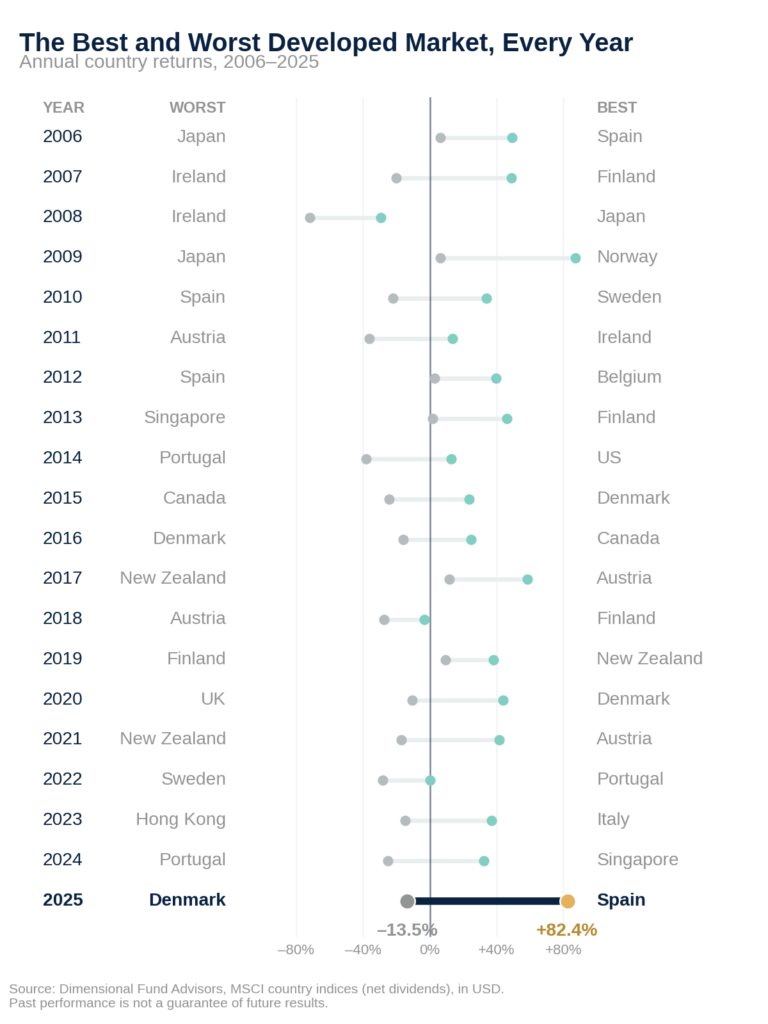
Last year, the gap between the best and worst performing developed stock market was nearly 96 percentage points. Both countries were in Europe.
- Developed markets are the world’s most established economies, each with its own stock market. In any given year, those markets produce wildly different results.
- In 2025, Denmark’s market lost 13.5% while Spain’s gained 82.4%. Same year, same global economy, a 96-point difference in outcome. That was the widest gap in twenty years.
- This isn’t unusual, only larger than normal. From 2006 through 2025, the average gap between the best and worst developed market was 50 percentage points, with the average loser down 16.4% and the average winner up 34.0%.
- The winners don’t stay winners. Denmark was the best-performing developed market in 2015 and the worst in 2016. It did it again, best in 2020 and worst in 2025. Scan the columns and you’ll see the same countries trading places over and over.
- Diversification doesn’t promise gains. In 2008 and again in 2018, even the best-performing developed market finished the year down. What owning all of them does is narrow the range of what can happen to you, not guarantee the direction.
- It also isn’t a story of constant losses. In six of those twenty years, even the worst developed market finished positive.
Financial takeaway: Owning a globally diversified portfolio means you will never hold the best-performing country, and you will never hold the worst. That’s the trade. It feels unsatisfying every single year, which is exactly why a plan shouldn’t depend on guessing which market is about to have its turn.
📰🎧🍿What I’m Reading, Listening To, and Watching
🎢 Crazy days in the stock market
Owen Lamont on a July when the index looked calm while individual stocks gained and lost the value of entire cities in a single session.
🎲 Do You Really Want to Be a Billionaire?
Victor Haghani and the Elm team on the strategy that maximizes your odds of becoming a billionaire, and the catch that makes it a terrible idea.
🧭 What’s a Safe Withdrawal Rate After You’ve Already Retired?
Amy Arnott on why the 4% rule answers a question most retirees have already moved past, and why a strong market has likely left many of them spending less than they could.
🧾 How Much Can You Afford to Spend on this Remodel?
Meg Bartelt on treating a remodel as a voluntary expense rather than an investment, and how to know whether yours actually fits.
🎓 Which Graduate Degrees Are the Best Investment? (Why I Skipped My MBA)
Nick Maggiulli on the counterfactual that killed his MBA plans, and what he did with the two years instead.
🏡Behind the Scenes
“What! She wasn’t supposed to come until late September!”
That was my son, age four, on being told he had a sister.
He was right, of course. The anticipated due date wasn’t until around October 1st. Stephanie had a routine appointment on September 8th, baby in the right position, everything on track, nothing worth reporting.
That night, after we put him to bed around nine, Stephanie told me she had a headache and her blood pressure was high. She kept checking it. It wasn’t coming down. At 10:30pm she called the advice nurse, who told her to pack a bag and go into Hoag Irvine.
I called her mother, who was at our house by 11:30pm to stay with our son. He slept through the entire thing from the comfort of his room.
By the time I joined Stephanie at the hospital, she was feeling better and her numbers had settled. She wondered aloud whether she’d overreacted and pulled everyone out of bed unnecessarily. We agreed it was the right call to take it seriously and get a professional opinion.
A few minutes later, the doctor came in and told us we’d be having a baby within a few hours.
It was past midnight, which put us at 37 weeks and 0 days. We had thought we had three more weeks.
So we spent the next hour doing what we could. Cancelled the next day’s meetings. Emailed customer support about the bolts missing from the bassinet. Had a few packs of preemie diapers ship overnight. Ordered the gifts that baby would be giving her big brother at their first meeting. All of it from a hospital chair.
Then they took Stephanie to prep, and I waited alone for 45 minutes. With our son, labor had taken just over 24 hours. This time, 45 minutes was the longest part of the night.
Our daughter was born at 3:43am, five pounds even.
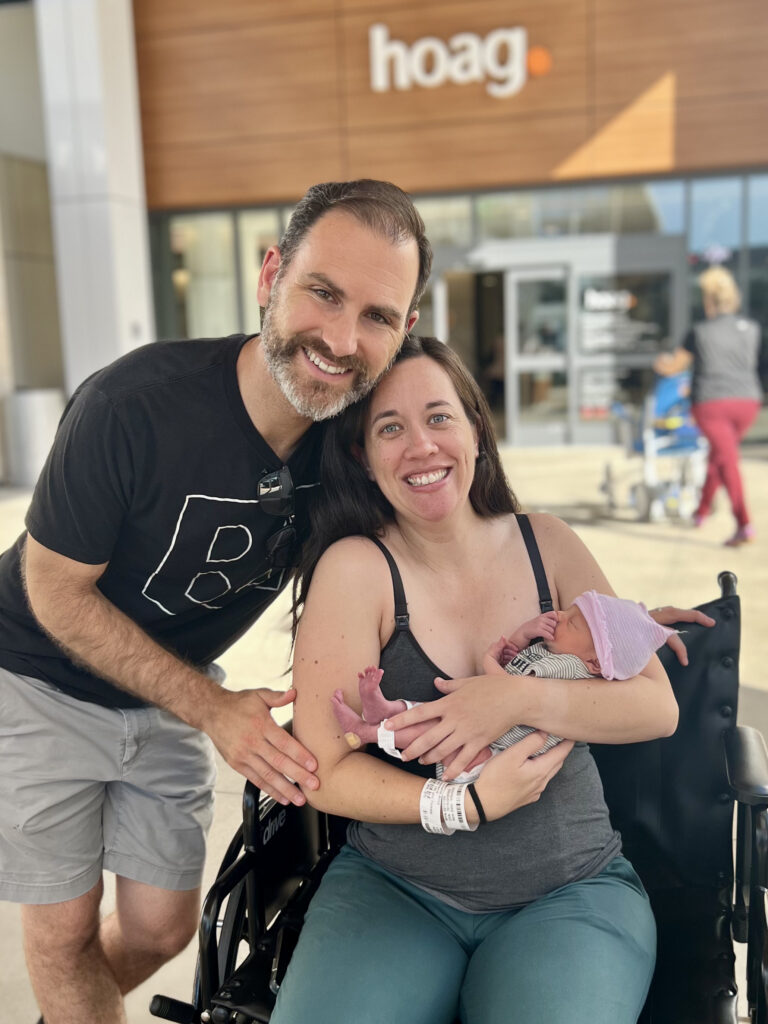
We had been preparing for her arrival for months, and now it was real. It was a lot at once, and mostly good. There were a few minutes at the start where the team was helping our daughter settle while Stephanie was still being cared for, and I was aware of being able to do very little for either of them. Both came through it beautifully. Then I got to sit with my daughter and hold her.
Afterward they moved us to a room and we were able to stay together. Nobody but the baby slept. That was its own kind of gift: when our son was born, his first week was spent in the NICU, where our time together was quite limited.
At 6:30am, I drove home so I’d be there when my son woke up.
Which is where the line at the top comes in. What I haven’t mentioned is that it was also, more or less, what Stephanie and I had said to each other at midnight. He just said it with better timing.
I showed him pictures. He listened, nodded, and then went to find our cat, Ollie, so he could deliver the news personally. We split a chocolate croissant I’d grabbed on the way out of the hospital, and I took him to Pre-K.
We’re all home now. Stephanie is recovering well. Our daughter is small and growing, and she looks so much like her brother did in his first days that I keep doing a double take, the same face, the same mannerisms. They also both arrived three weeks early, entirely on their own schedule. Her big brother has turned out to be much gentler with her than I expected a four-year-old to be.
It wasn’t the exact plan, but we were ready enough. Stephanie trusted her instincts that night, and I’ll be forever grateful for that. We’ve had a lot of help since, too — from her mother, who drove over at midnight without being asked twice, to the doctors and nurses who cared for us, to the friends and family who’ve shown up in every small way. We’re glad to be home, all four of us.


Are you overpaying taxes?
Take the 2-minute quiz to find out.
EXPLORE TOPICS


Start Your Next Chapter and Pursue Exciting Financial Goals
Click below and schedule a complimentary consultation
Similar Posts


Affinity Insider | August 2026
August 27, 2026
Affinity Insider | July 2026
July 28, 2026

Affinity Insider | June 2026
June 24, 2026
No results found.