A Financial Roadmap for Expecting Parents

Three phases, from pregnancy through year one
Housing. Insurance. Leave. Childcare. Estate documents. College savings.
The decisions arrive compressed and the stakes feel high, so every one of them feels like it needs an answer now.
You do not need every answer. You need an order.
Most of the advice available to you is a list. A list tells you what to consider. It does not tell you what to do first, or what can wait.
And underneath the list is something a list cannot capture. Preparing financially for a child is rarely about buying more stuff. It is about preparing your life to absorb change gracefully.
I write this as a father of two and as a financial advisor. The second is why I can lay out the sequence. The first is why I know it does not feel this orderly while you are in it.
Why order matters more than speed
Financial decisions are always connected. In this season they are coupled more tightly than usual, and several of them simply cannot be answered until others are.
Your cash reserve is the clearest case. You cannot size it properly until you know what leave actually pays and what childcare actually costs where you live. Pick a number before you know those two things and you have not saved any time. You have committed to a figure you will have to revise.
Housing behaves the same way. Choosing a neighborhood before pricing childcare and the commute there can change what the house costs you by more than the difference in the mortgage.
And if a home purchase is on the table at all, it moves nearly everything else. It changes how much life insurance makes sense, because the mortgage becomes part of what your family depends on. It changes your reserve target, because a bigger house carries a higher monthly floor. It raises the urgency of the estate plan, because there is now real property to direct.
So start with the decision that moves the most other decisions. Let the rest follow.
Urgent, important, or both
You have a finite amount of attention, and this season will ask for more of it than any you have had before. Sleep goes first. Focus goes with it. Work rarely slows down to compensate, and for most people at this stage of a career it is accelerating.
Which means the real risk is not making a wrong choice. It is making none. Feeling the weight of the full list, deciding you cannot do it properly right now, and doing nothing at all.
The arrival of a child is a genuine deadline. That creates real urgency, and some things cannot wait. But urgency and importance are not the same thing, and confusing them is what makes this season feel unmanageable.
Urgent items have a window that closes. Adding your child to health insurance. Getting on a childcare waitlist. Applying for life insurance inside the window carriers are comfortable with.
Important items shape decades but tolerate a few months. College savings. Housing direction. The long-term investment plan.
Both describes the small number of things that are time-sensitive and consequential. Understanding your leave benefits. Sizing your cash reserve. Naming a guardian.
Sorted this way, the list becomes something you work through rather than something you carry.
Many of the best decisions during this season are not perfect decisions. They are simply thoughtful, flexible, and good enough for the stage of life you are in.
What follows covers three periods: before the baby arrives, the first ninety days, and year one and beyond.
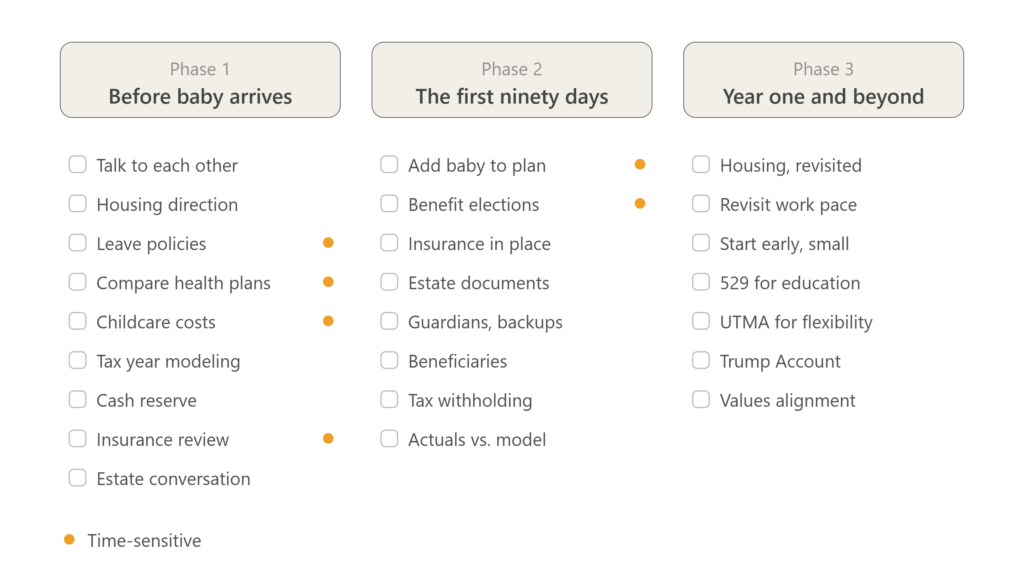
Phase 1: Before the baby arrives
This phase is about direction. You are deciding what kind of year you are about to have.
💬 Talk to each other before you talk to anyone else. This is planning, not paperwork, and it only works as a joint act. Most couples find that the individual financial decisions get easier once the two of you are aligned on the bigger picture. Conversations about flexibility, support systems, commute, career goals, and what you want a normal week to feel like tend to produce more clarity than the numbers do, because they tell you what the numbers are for.
You may also discover you disagree about something substantial. Private school. How much house is enough. Whether one of you wants to keep working at this pace. Better to find that out now, while it is still a conversation, than after the commitments are made. Crafting Your Couple’s Money Philosophy is built for exactly this conversation.
🏡 Then clarify housing and lifestyle direction. The question is rarely “what house should we buy?” The better question is “what kind of life are we trying to support as a growing family?” Staying in your current home longer is a legitimate answer. So is renting for near-term flexibility. So is buying sooner. Each carries different implications for savings, cash flow, and long-term goals, and the right answer depends on what you are actually trying to build. I wrote more about how to work through that question in Before You Search: Defining What Home Means to You.
🔄 Expect the shape of your spending to change, not just the total. The most common planning error at this stage is quiet and hard to argue with: the assumption that life will continue as it does now, with a child added to it. It will not. Priorities move. Some spending you thought was essential turns out not to be, and things you never budgeted for become non-negotiable. Travel changes. Restaurants change. What you want your weekends to look like changes.
This is not a loss. It is the point. But a plan built on the assumption that nothing else moves will be wrong within a year, and that is a sign the forecast needed updating rather than a sign you got it wrong.
A child is not added to your life. Your life reorganizes around one.
📋 Read the actual leave policy. Both of you. Not the summary, and not what a colleague told you. The variation here is enormous, and it is the most underestimated part of this planning. Two people with similar titles at similar companies can face completely different realities. One gets sixteen weeks fully paid. The other gets six weeks at partial pay with an unspoken expectation of availability throughout. Some policies distinguish between birth recovery and bonding leave. Some coordinate with state programs. Some do not.
For each of you, find out:
- How many weeks you get
- How much of it is paid
- How any state disability or paid family leave program interacts with employer pay
- What the actual expectation is around being reachable
Then decide whether to take leave concurrently or stagger it. Staggering often extends coverage at home and reduces the childcare bill in the most expensive months, but it also means the two of you overlap less during the hardest stretch. That is a real trade, and it deserves to be a deliberate one.
Either way, there will be a stretch where one income is temporarily carrying more weight than it has before. How long that stretch lasts, and how much of the gap it has to cover, is the number everything else in this phase depends on.
🏥 Compare both health plans before you are forced to choose. If you and your spouse are covered by different employers, adding a child is a decision, not a formality. Most people default to whichever plan the birth parent already has. That is often wrong.
Run the numbers on adding the child to each plan separately, and compare total annual cost rather than premium alone. That means premium plus deductible plus out-of-pocket maximum. It means knowing whether the plan uses an embedded deductible or a single family deductible, because in a year with a birth in it that difference can be worth thousands. Check whether your pediatrician is in network on both. Check how family enrollment affects HSA contribution limits if either plan is high deductible.
One detail that catches nearly everyone: check your due date against the plan year. A baby due in late December is a materially different financial event than one due in early January. Meet your out-of-pocket maximum in December and the plan year resets weeks later, which can mean facing much of it again while you are still in the hospital billing cycle. You cannot move the due date. You can plan around it.
For the mechanics of reading a plan properly, see my open enrollment guide.
Do this work while you are pregnant. Afterward you will be making the same decision on four hours of sleep against a deadline.
🍼 Price childcare where you actually live. National and statewide averages will mislead you badly in high-cost metros. As of 2026, center-based infant care in Los Angeles generally runs between $1,900 and $2,900 per month, with Westside and South Bay programs at the top of that range and the Valley and Eastside meaningfully below it. San Francisco runs higher still, with center infant care in the city commonly above $2,300 per month and full-time nannies averaging well north of $5,000. A nanny share often lands between the two.
Two things follow. Infant care is the most expensive year, so savings you find in year one are worth more than any optimization later. And waitlists at desirable programs in both metros frequently run six months or longer, which means the decision often has to be made during pregnancy whether you feel ready or not.
🧮 Model the income year, not just the month. Once you know what leave actually pays, you can see the tax year clearly. A leave year is often an unusual one, and unusual tax years are opportunities if you see them coming. Income may drop. Deductions and credits change with a new dependent. Depending on the size of the gap, this may be a better year than usual for certain tax moves and a worse year for others.
State programs add a wrinkle worth checking wherever you live. In California, for example, paid family leave benefits are generally subject to federal income tax but not state income tax, and withholding is not automatic. State disability benefits are generally treated differently. Rules vary considerably by state, and if nobody looks at this in advance, the result is a tax bill in April during the year you have the least slack.
This is the difference between filing a return and planning for one, which I covered in Tax Prep vs. Tax Planning.
💵 Set your reserve against the actual gap. Generic guidance says three to six months of expenses. That is a starting point, not an answer, and I made the fuller case for sizing it deliberately in Your Cash Savings Buffer. Size the reserve against what you can now calculate: the unpaid or partially paid portion of leave, the first several months of childcare, higher out-of-pocket medical costs in a birth year, and whatever cushion lets you make decisions without pressure. For most dual-income households facing metro-level childcare costs, that math produces a larger number than the rule of thumb does.
If you are facing significant family-building costs, surrogacy being the clearest example, building a substantial cash position in high-yield savings generally takes priority over directing surplus toward aggressive investing.
🛡️ Review your protection coverage. Term life becomes materially more important once a child and a mortgage are in the picture. Employer coverage is the common default, is frequently insufficient, and typically ends when the job does. Review both spouses’ group life and disability benefits, identify the gaps, and price term coverage.
Timing matters more than people expect, and it only constrains the pregnant parent. Most carriers are comfortable issuing somewhere between roughly weeks 13 and 28. Many postpone applications during the first trimester, and some postpone after about week 32 because delivery is close. Complications such as gestational diabetes or preeclampsia can mean a delay or a rating, and certain postpartum conditions can affect eligibility for a while afterward. The non-pregnant spouse faces none of this and can apply at any point. If term coverage is on your list, the second trimester is the window.
Umbrella, property, and auto belong in the same review.
📜 Open the estate planning conversation. You do not have to finish it now. You do have to start it, because it is the item most often deferred and the most consequential when it is. Finding an estate attorney takes longer than people expect, so starting the search during pregnancy is usually what makes the documents possible in phase two.
Phase 2: The first ninety days
This phase is execution. Two items have windows that close. The rest are important but will wait a few weeks while you sleep.
Do these first
⏱️ Add your child to health insurance. Birth is a qualifying life event and the window is short. In many employer plans it is roughly thirty days, though some allow longer, so confirm yours. Coverage is generally retroactive to the date of birth if you enroll in time, and a serious problem if you do not. This is the most common expensive mistake on the entire list, and it is entirely avoidable.
🗂️ Update your benefit elections. The dependent care FSA limit rose to $7,500 for 2026, the first meaningful increase since 1986. Two caveats. Employers are not required to adopt the higher limit, and your plan document controls the real cap, so you may be held to $5,000 or somewhere in between. And in workforces with many highly compensated employees, nondiscrimination testing can reduce what higher earners are permitted to elect. Confirm your number rather than assuming it. Revisit HSA family coverage and anything else tied to dependent status at the same time.
Then these
✒️ Convert the insurance analysis into actual coverage. The work you did during pregnancy now has a real answer attached to it. If no one depends on your income, life insurance may not be necessary. That is no longer your situation.
⚖️ Execute the estate documents. For most families with young children this means a revocable living trust, a will, an advance healthcare directive, and a financial power of attorney, drafted by an estate attorney. The trust keeps the estate out of probate, preserves privacy, and keeps the outcome from being decided by state default rules. I walked through what makes these documents actually work, rather than just exist, in The Estate Plan That Actually Works.
👪 Name guardians, and name backups. Guardianship designations are the reason most parents finally complete this work. Name successor trustees and executors as well, with alternates for each. Trust provisions should address what happens if your children inherit while still minors, so assets are managed rather than handed over outright at eighteen.
If you expect more children, say so now. A trust can either include provisions covering future descendants or be restated later when the next child arrives. Handling it deliberately is simple. Discovering the omission years later is not.
🔁 Update beneficiary designations. Retirement accounts, life insurance policies, and transfer-on-death registrations pass by designation, not by will. A perfect estate plan paired with a stale beneficiary form produces the wrong result, and nobody discovers it until it matters.
A perfect estate plan paired with a stale beneficiary form produces the wrong result.
🧾 Update your tax withholding. You now have a dependent, and your W-4 does not know that. Credits and filing details change, and if either of you took partially paid leave, this year’s income looks different from what your withholding assumes. Ten minutes here prevents a surprise in April, in either direction.
📊 Compare the actuals to what you modeled. During pregnancy you were working from estimates. By month three you have real numbers: what leave actually paid, what childcare actually costs, what the medical bills came to. Put them next to the projections and adjust the savings rate, the target balances, and the automation accordingly. This is the step that turns a plan into a working system, and it is the one most people skip because the estimates felt settled.
Phase 3: Year one and beyond
This phase is refinement, and it repeats.
📐 Revisit the housing decision you made before the baby. You chose in phase one using pre-baby information. Year one is when you find out whether you were right. The question is not only whether you can make the payment, but whether the payment still leaves room for the flexibility you said you wanted when you had this conversation the first time.
⏳ Revisit whether both of you want to keep working at this pace. A meaningful number of couples arrive at this question having been certain they would not. One spouse wants to reduce hours, change fields, or step back entirely. There is no correct answer, and I am not advocating either direction. What matters is that the option stays open, which depends almost entirely on the fixed commitments you took on in the first two years. A household with room in its cash flow gets to decide. A household without it does not.
🌱 Start early, even small. The early years do the most compounding work, and they cannot be recovered later by contributing more. A modest automated contribution started now outperforms a larger one started in five years. You do not need a meaningful number to begin. You need a number and a start date.
Then match the account to the question you are actually answering, because the three common options solve genuinely different problems.
🎓 A 529 for education. Contributions grow tax-free when the money is used for qualified education expenses, which is the most favorable treatment available for this purpose. Flexibility has improved in recent years, including options for unused balances, which addresses the objection most parents raise first.
🎁 An UTMA or UGMA for flexibility. The money can be used for anything that benefits the child, not just education, which makes it the right answer when the purpose is genuinely open. The trade is control. The account becomes theirs outright at the age of majority, and what they do with it then is their decision.
🏦 A Trump Account for the long horizon. Available since July 2026, it functions as a starter retirement account: after-tax contributions, tax-deferred growth, and a $1,000 federal seed for children born 2025 through 2028. Funds stay put until the child turns eighteen and cannot be moved into a 529 or UTMA in the meantime. The appeal is the time horizon. Money invested at birth for retirement gets up to six decades of tax-deferred compounding, which no other vehicle on this list can offer.
Decide what the money is for before deciding where it goes. Education, general flexibility, and long-horizon retirement funding are three different goals, and the wrong vehicle for the right goal is a costly kind of tidy.
❤️ Keep cash flow aligned with what you value. How a household spends is the clearest statement of its priorities it will ever produce.
A household with room in its cash flow gets to decide. A household without it does not.
A word about pressure
There is a version of this planning that goes wrong even when every item is completed correctly.
It starts with a story most new parents tell themselves without noticing. That providing well and loving well are the same thing. That a good parent gives their child every advantage available. The story arrives from everywhere at once, from social media, from the families around you, from whatever you did or did not have growing up.
The financial expression of it is familiar. Full-time nanny. Private school from kindergarten through twelfth grade. A larger house in a better district. A second car. Each decision is defensible on its own. Together they can commit a household to a level of spending that requires both parents to keep earning at their current pace indefinitely, which is precisely the flexibility most new parents say they want more of.
I am not arguing against any of those choices. I am arguing that they should be chosen rather than absorbed. A family that deliberately picks the ones that matter most to them and says no to the rest is usually in a stronger position, financially and otherwise, than one that says yes to everything because saying no felt like a failure of love.
Ask what you are actually trying to give your child. Then check whether the spending in front of you delivers it.
A growing family quietly reshapes how you think about time, flexibility, career, housing, risk, and even what “enough” means. It is worth deciding on that last one yourself rather than inheriting someone else’s answer. That is the whole argument of Purpose Before Goals, and the workbook there is the exercise I would point you to first.
The roadmap is not a checklist
You will not finish this list in one swoop. That is not a failure of execution. Time, energy, and attention are finite, and they are in unusually short supply right now.
You also do not have to do it alone. Most of what makes this season overwhelming is not the difficulty of any single decision. It is holding all of them in your head at the same time while running on very little sleep.
A plan for a growing family is a sequence you revisit, not a project you complete. Another child arrives. A job changes. A home changes. The plan is built to change with them, and reviewing it as things move is the work, not evidence that you got it wrong the first time.
What you can control is the order. Take the decisions in a sequence where each one makes the next easier.
Start with direction. Move to protection. Then build.
The arrival of a child rarely makes life feel more controllable. But thoughtful planning can create real clarity, flexibility, and confidence for the road ahead.
Find out which items are actually yours
The roadmap above puts the decisions in order. The next step is narrowing them to your situation, because no family faces all of it.
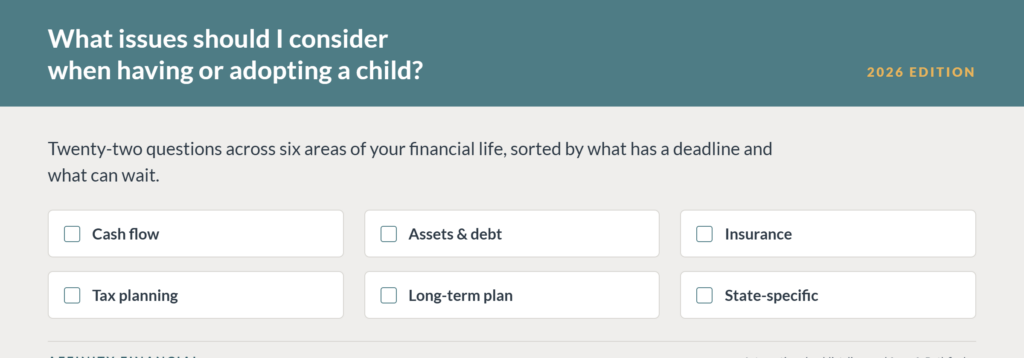
The interactive checklist walks through the financial, tax, insurance, and estate considerations that come with a new child, and it asks about your circumstances as it goes. What comes back is sorted by what applies to you, it separates the items with a closing window from the ones that simply matter, and it leaves room for the context only you can add.
A few minutes now replaces the feeling of holding all of it in your head at once.
Disclaimer: This article is for general informational purposes only and is not intended to provide, and should not be relied on for, legal, tax, or accounting advice. Please consult a qualified estate planning attorney or tax advisor regarding your individual circumstances.
Derek Pantele, CFP®, CFA is the founder of Affinity Financial, a wealth advisory firm based in Orange, CA. He works with professionals and families navigating major financial decisions, including equity compensation, liquidity events, and long-term wealth planning.
Are you overpaying taxes?
Take the 2-minute quiz to find out.
EXPLORE TOPICS


Start Your Next Chapter and Pursue Exciting Financial Goals
Click below and schedule a complimentary consultation